After more than a dozen years here at Boulder SEO Marketing, we’ve seen many changes in SEO. But nothing compares to what we’re experiencing with AI integration right now.
If you’re a business owner trying to get found on Google and show up in AI search results, you’re probably asking the same question everyone else is: How do we use AI without everything feeling generic and robotic?
That’s exactly what we want to address in this week’s Friday SEO Tip. Because the reality is that AI can be incredibly powerful for your business, but only if you use it correctly. And right now, most agencies are getting it completely wrong.
Watch the video above to learn more.
Here’s what’s happening in the SEO landscape today. Agencies are going in one of two directions. The first group is completely ignoring AI. They’re doing everything the old way, which means they’re falling behind. They can’t keep up with the volume demands of modern SEO, and they’re slower than competitors who have figured out how to leverage AI effectively. The second group is throwing AI at everything. They’re using ChatGPT to generate dozens of blog posts per month, publishing everything with minimal review, and turning out content that all sounds exactly the same. Users can smell this from a mile away. Google is getting better at identifying it. And these agencies are actively harming their clients’ rankings.
Neither approach works. The question becomes: Is there a middle ground? Can you actually use AI to get more done without sacrificing what makes your work valuable? After spending the last few years building, integrating, and using AI systems at our agency, we can tell you unequivocally that the answer is yes. But it requires a specific approach.
Why Greg Is the Right Person to Explain This
Before we dive into the framework, let us give you some context on why our Senior Project Manager, Greg Noonan, is speaking on this from Boulder SEO Marketing. Before working in digital marketing and SEO, Greg was a scientific researcher. He studied atmospheric science and meteorology at the University of Colorado. He spent years analyzing data, building models, and testing scientific hypotheses.
That background has been surprisingly useful, especially lately. When we started integrating AI into our workflows, Greg approached it the same way he would approach any scientific research problem. Test it. Measure it. Figure out where it actually adds value and where it falls short. Greg helped build both versions of BSM Copilot, our internal AI system. Now he manages what we call a hybrid team: both people and AI working together. That’s a very important distinction. Both people and AI are working together.
The 60-40 Framework That Actually Works
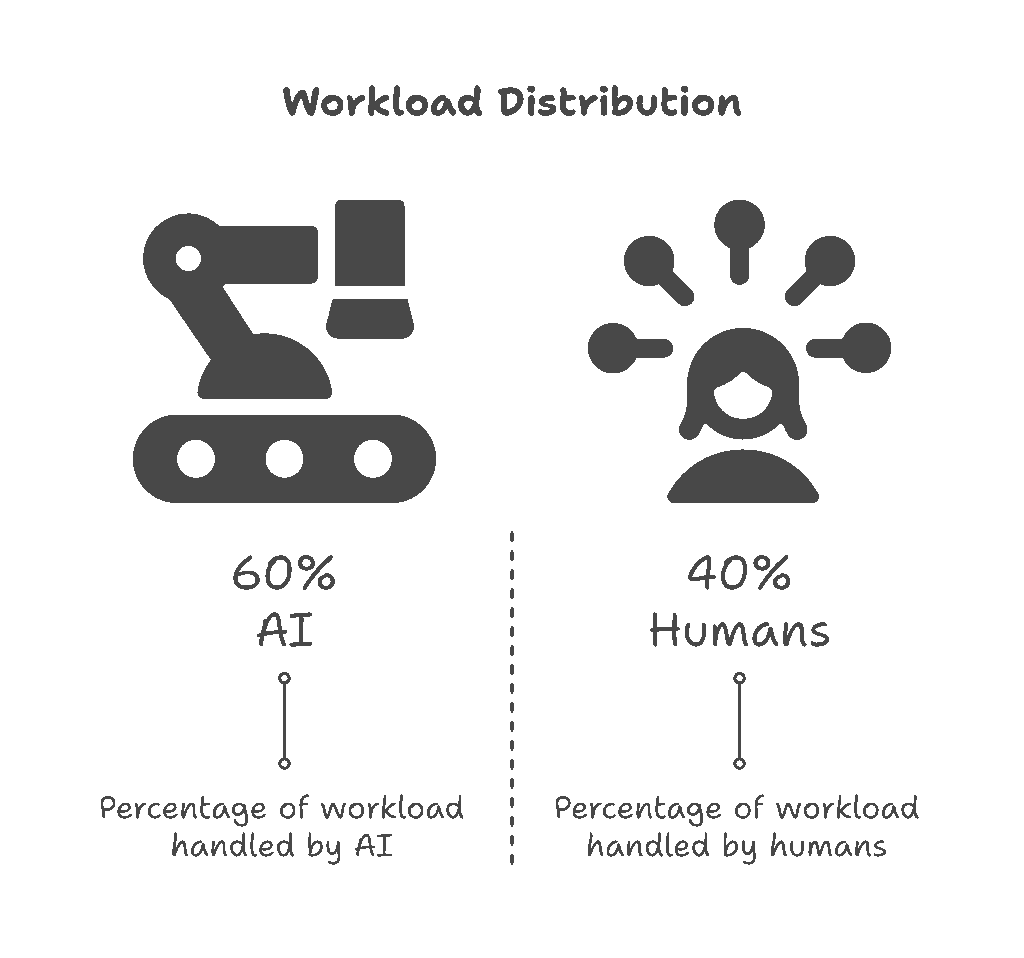
You can think of it this way: AI handles the volume, while human expertise adds value. Here’s the framework we use. We think of it as the 60-40 rule.
AI handles roughly 60% of the work. That’s the repetitive, time-consuming stuff. Research, data processing, first drafts, formatting. Humans handle 40%. That’s the part that actually requires expertise, judgment, and the human touch. The strategy calls. The quality reviews. The client communication. The creative decision-making. And here’s the key: that 40% is where the value lives.
In practice, this means our team can now manage more work without sacrificing quality. The AI handles the volume, and our team can focus on the parts that actually require years of experience. Before AI, if we spent 10 hours on a project, maybe four of those hours were high-value strategic work. The rest was minutiae: research, formatting, organizing. Now we can compress those 10 hours into 6 hours. And more of those hours are spent on the work that actually matters.
That’s the real benefit. We’re not looking to replace people. We’re looking to free them up to do what they’re actually good at and what matters.
So, where does AI actually excel within our workflows at Boulder SEO Marketing? Competitive research is a big one. AI can analyze 10 competitor websites in the same time it takes a person to do one. It pulls out patterns, identifies gaps, and surfaces opportunities that our clients can use that their competitors may be missing. What once required days of research is now accomplished in a matter of hours.
First draft outlines are another area where AI shines. When we’re creating content like blog posts, page content, or press releases, AI can build a solid framework based on keyword research and competitive analysis. This gives us a starting point instead of a blank page. Then there’s data processing: things like pulling reports, organizing information, and formatting deliverables. That’s the repetitive stuff that used to eat up hours and hours of employee time.
On the flip side, here are the things AI is not good at. Strategy, for one. AI can’t look at your business, understand your competitive landscape, and tell you where to focus. That requires experience and judgment. A human who’s been doing this for years can see patterns and opportunities that AI simply can’t. Quality control is another critical area. Everything that leaves our team gets reviewed by a human. Period. AI makes mistakes. It hallucinates. It misses nuances. Someone with expertise needs to catch all of that before it goes to a client.
And then there’s client relationships. AI can’t hop on a call with a client who’s frustrated about rankings and help them understand what’s happening. That takes a person who knows their business. It takes the human touch. These are the areas where human expertise is absolutely non-negotiable, and where agencies get into serious trouble when they try to automate them.
The Critical Mistake Agencies Keep Making
This is where many agencies are getting it wrong, and it’s worth spending time on because it’s such a widespread problem. We’ve seen agencies that basically let AI write everything. They do a quick skim, and then they publish it. That’s a mistake for several reasons.
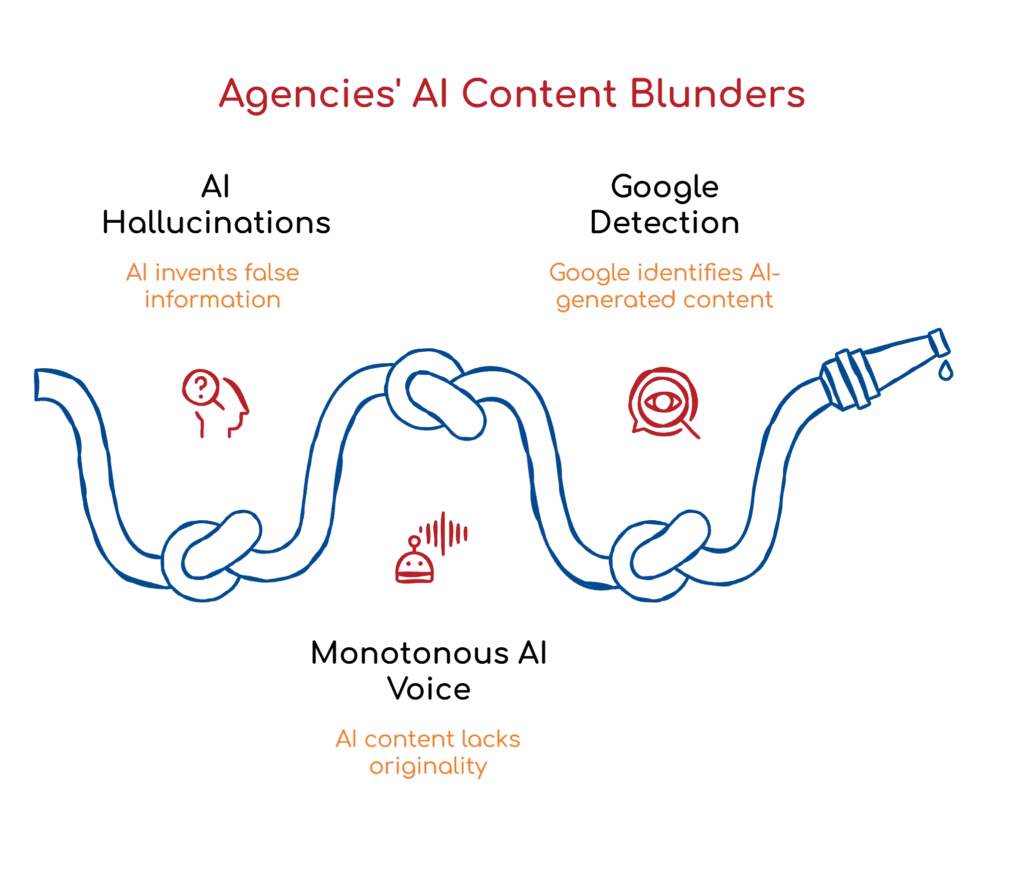
- AI makes things up. It sounds confident even when it’s wrong. If you don’t have somebody who actually knows the subject reviewing the content, you’re going to publish inaccurate information. We’ve seen this happen repeatedly: an AI-generated article that sounds authoritative but contains fundamental errors that any expert in the field would catch immediately.
- AI tends to sound the same. You’ve all seen it. There’s a certain flatness to AI content. Generic transitions, predictable structure, lack of personality. Readers notice. They can’t always articulate why, but it feels like it was generated by AI at first glance. The voice is bland. The examples are generic. The insights are surface-level. It’s like reading a term paper written by someone who doesn’t actually care about the topic.
- Google is getting better at identifying AI-generated content. If your content doesn’t have genuine expertise and originality, it’s going to struggle to rank. That’s a big issue for both search engine optimization and generative engine optimization. Google’s algorithms are increasingly sophisticated at detecting patterns that indicate content was created solely by AI, without meaningful human input.
Bottom line: Here at Boulder SEO Marketing, nothing goes out without review by one or more of our colleagues. AI can give us the first draft, the research, and the framework. But a human with expertise has to shape it, fact-check it, and make sure it actually sounds like something a human would write. That’s the human touch part. And that’s non-negotiable.
How to Actually Implement This in Your Business
If you’re thinking about how to integrate AI into your own business, here’s what we would suggest based on what’s actually worked for us over the last few years.
Start with the boring stuff. Data entry, research, first drafts, formatting. Let AI handle the tasks that eat up time and don’t require your expertise. These are the perfect testing grounds for AI because the stakes are lower and the patterns are more repetitive. If the AI messes up a data formatting task, it’s easy to catch and fix. If the AI messes up strategic direction for a major client, that’s a much bigger problem.
Keep your team focused on strategy and quality. Don’t let AI make decisions or publish content without human review. Your expertise is what makes your work valuable. This is something we emphasize constantly with our team: the AI is a tool that makes you more effective, not a replacement for your judgment and experience. The moment you start trusting AI to make strategic calls or publish content without review, you’re on dangerous ground.
Train your AI. The more context you can give your AI agents about your business, your clients, and your voice, the better the AI will perform. At Boulder SEO Marketing, we’ve spent months feeding BSM Copilot our processes, styles, guides, and past work. That’s why it works for us. A generic AI tool off the shelf is going to give you generic results. An AI system that’s been trained on your specific way of doing things, your industry knowledge, and your quality standards will perform dramatically better.
Measure the results. Track whether AI is actually saving time and maintaining quality. If the output is garbage, it’s not really saving anybody anything. We track metrics such as time to completion, the number of revision rounds, and client satisfaction scores. This helps us understand which AI applications are actually adding value and which ones need more refinement or should be abandoned entirely.
The reality is that AI integration is an ongoing process, not a one-time implementation. New tools emerge constantly. Existing tools get better. Your understanding of where AI helps and where it hinders evolves with experience. The scientific approach Greg brought to this: test, measure, iterate, has been essential to making this work effectively.
What This Means for the Future
AI isn’t going to replace your team. But it can make your team a lot more effective if you use it right. The key is finding that balance. Let AI handle the volume while your humans focus on the value.
The agencies that figure this out will have a significant competitive advantage. They’ll be able to deliver more work, faster, without sacrificing quality. They’ll be able to take on more clients without increasing headcount in proportion. They’ll be able to compete on both speed and quality in ways that weren’t possible before.
The agencies that don’t figure this out will fall into one of those two extremes we talked about at the beginning. Either they’ll be the slow, expensive option that can’t keep up with volume demands, or they’ll be the cheap, fast option that produces mediocre work. Neither of those is a good position to be in.
If you’re curious about how we’ve integrated AI into our SEO workflows at Boulder SEO Marketing, or if you want to see what a hybrid approach looks like in practice, that’s exactly what we do here every day. We’d be happy to talk through how this framework might apply to your specific situation.
Have an amazing Friday and a great weekend.
Stay safe and healthy.
The Boulder SEO Marketing Team