Hello and happy Friday! When was the last time you watched a YouTube video show up directly in a Google search result? If you have been paying any attention to search lately, you have probably noticed it is happening constantly. And if your business is not showing up in those results, you are almost certainly leaving opportunity on the table.
Here is something our team has been saying a lot lately: podcasts and YouTube videos are now some of the most cited resources in Google AI Overviews and across AI search platforms like ChatGPT, Claude, and Perplexity. These large language models are actively feeding on this content because it is net-new, human-generated, and nearly impossible to manufacture at scale. That changes everything about how businesses should think about podcasting as a marketing strategy. Watch the full video above to learn more.
This week, our founder, Chris Raulf, sat down with Austin Willman, Partnerships Manager and podcast host at Digital Web Solutions. Austin runs the e-Coffee with Experts podcast, where he interviews global agency leaders and marketing professionals. He recently had Chris on as a guest, and after they wrapped the recording, the conversation turned into something worth an episode of its own. Chris invited him back, and this week’s Friday SEO Tip is the result.
What they cover goes well beyond podcasting as a branding exercise. This is a conversation about podcasting as a core GEO (Generative Engine Optimization) strategy. Here are the key points.
Why YouTube Is the Most Important Platform in AI Search Right Now
YouTube, owned by Google, is the top social platform cited in Google AI Overviews. Not LinkedIn, not X, not your blog. YouTube. And podcasts that live on YouTube are a massive part of that equation. The reason is straightforward: AI systems are looking for text they can understand, verify, and trust. A podcast transcript is natural, human-generated language that has not been keyword-stuffed or manufactured to game an algorithm. It is a real conversation between real people, and large language models can read those transcripts, extract the core meaning, and surface it in response to search queries.
Platforms like ChatGPT, Perplexity, and Claude are pulling heavily from video and podcast content precisely because it represents net-new information. When Chris sits down with someone like Austin, they produce content that has never existed before in exactly that form. They might cover topics that have been written about a thousand times, but that specific conversation, with those specific words and that specific context, is original. AI thrives on that originality. It is much harder to game than a blog post, and much easier for an algorithm to trust.
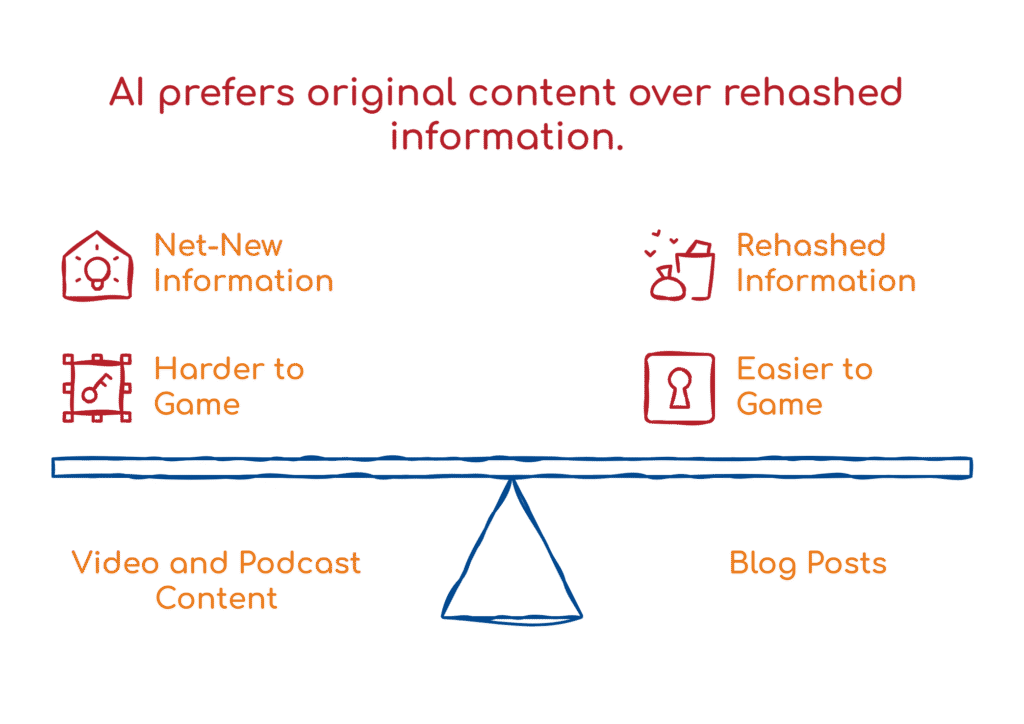
There is also a trust dynamic at play here that Austin articulated really well. Google and large language models do not want to be wrong or redundant. A podcast tackles both problems simultaneously. Chris can say the same core idea on ten different podcasts, but the words will never be exactly the same twice. Each episode is unique in its content, yet it reinforces the same concepts. That combination of consistency and uniqueness is exactly what AI search rewards.
The Entity Authority Angle Most People Miss
Here is something Austin said that most people completely overlook. In SEO, they talk about entities. An entity can be a person, a brand, or a concept. When two entities, in this case a podcast host and a guest, share a conversation, authority passes between them. This works the same way link juice flows between websites.
Think about it from a traditional SEO perspective. If a high-authority website links to your site, Google interprets that as a trust signal. Your site gets lifted by association. The same principle applies in podcasting. If a recognized expert appears on a podcast with you, your entity gets associated with theirs in the AI’s understanding of who knows what. The person with lower authority gets pulled up. The person with higher authority does not get dragged down.
Chris ranks number one on Google for the search term AI SEO expert. A significant part of that is because he appears on many podcasts, and if you search his name right now, you will see podcast interviews filling up page 1 of the results. After appearing on a high-quality show, he immediately saw a measurable boost in his personal brand and website rankings. That is not a coincidence. That is entity authority transfer in action, and it is as real as any backlink strategy you have ever run.
The takeaway is simple: if someone with genuine authority in your space invites you onto their podcast, say yes. Every single time. And if you are building your own show, think carefully about who you invite, because their authority becomes part of your content’s signal in AI search.
The Transcript Is More Valuable Than the Audio
This is the point most people building podcast strategies get completely backwards. Too much energy is spent on audio quality, intro music, and episode art. Those things matter for listener experience, but they are almost irrelevant to AI search performance. Austin put it plainly: AI is not listening to your voice. It is reading your text.
The transcript from any podcast episode is one of the most valuable content assets a business can produce. It can be used to train a custom AI persona. It can be broken into LinkedIn posts, newsletters, YouTube descriptions, and social clips. It can be fed into a system like BSM Copilot to generate net-new content that is fully grounded in your actual voice, expertise, and opinions. Not generic AI output. Actual content that sounds like you because it came from you.
Austin shared a great example of this in action. Through his venture Willman Ventures, he interviews founders on a podcast and then uses the transcripts to build their entire content ecosystem: newsletters, LinkedIn posts, and social media captions across platforms. The conversation itself becomes a coaching session. The transcript becomes the raw material for a full content strategy. One recording. Multiple formats. All of it is traceable back to real human expertise.
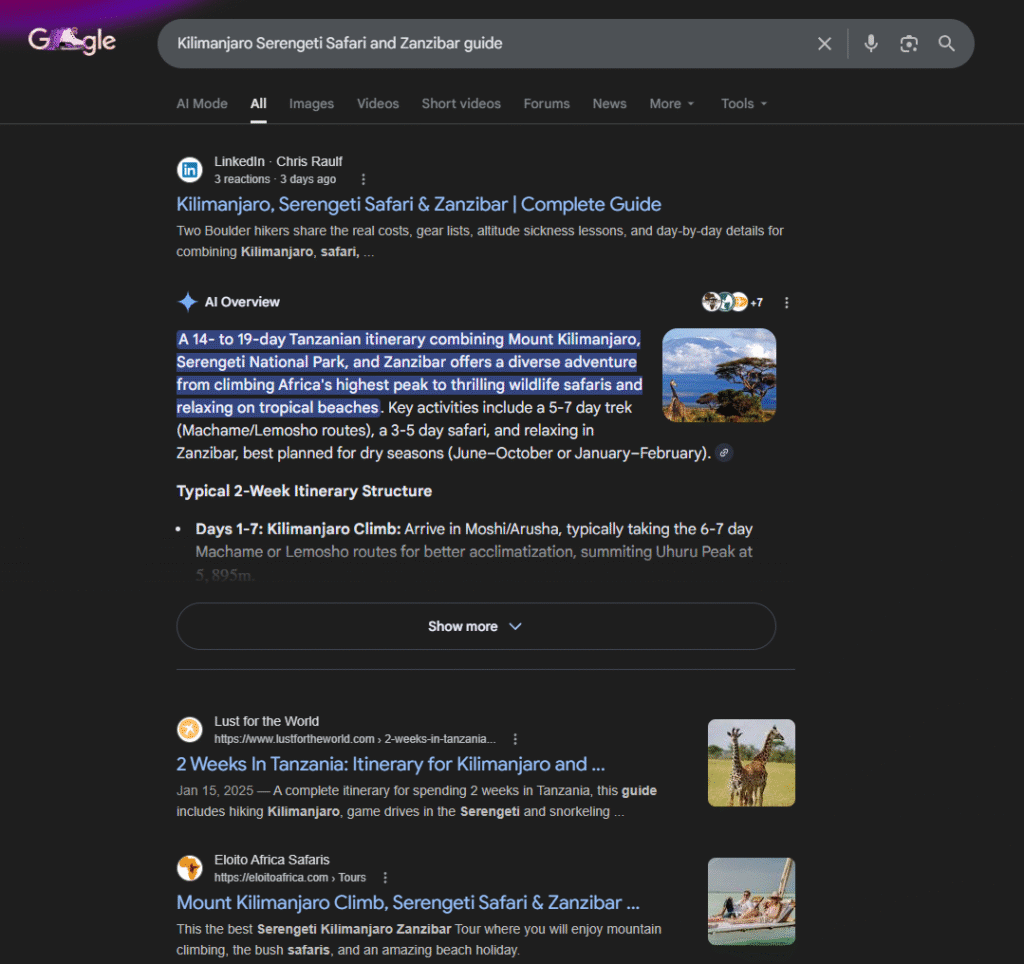
Chris has been doing something similar for a while now with Virtual Chris, a custom AI model built from his podcast transcripts, conference talks, and client calls. Everything goes into the knowledge base. On walks, he puts in an earbud, has Claude ask him questions about a topic he wants to write about, records his answers, and runs the transcript through a sophisticated prompting sequence to produce a finished piece of content. He recently used that exact technique to publish a travel guide about Kilimanjaro, Serengeti, and Zanzibar on LinkedIn. It ranked at the top of Google in under 24 hours. Same methodology, different application.
You Do Not Need a Studio. You Need to Start.
This is where most people get stuck. The assumption is that podcasting requires a studio, expensive equipment, and a production team. It does not. The barrier to entry is almost nothing, and this episode is proof of that.
Austin did not have a fancy camera when he first interviewed Chris. He started his podcast journey by facilitating in-person events where he was not the keynote speaker. He was the host, the connector. His name was on the flyer, but when people walked in, he welcomed them and brought the experts up to the stage. He was not the star. He was the one who made the stars accessible. That mindset, focusing on making your guest look good rather than showcasing yourself, is what separates a great podcast from a forgettable one.
The BSM team records the Friday SEO Tip series on Riverside, a simple browser-based recording tool that runs from a phone at a conference, in a client’s office, or at a kitchen table. Austin’s original podcast setup was a $25 microphone and a $15 ring light from Amazon. When Chris travels, he uses his Pixel camera as a webcam and Riverside to capture everything. If the content is valuable, production quality is secondary. Start imperfect and improve as you go.
And here is something worth considering, particularly for local service businesses. Chris recently attended a meeting with a company that excavates and repairs sewer lines. What a genuinely interesting topic for a podcast. When they are on a job site, they could record a five-minute conversation with a customer explaining what they found, why it matters, and what they did to fix it. That kind of content, filmed on a phone and uploaded to YouTube with a transcript, is exactly the type of net-new, location-specific, expertise-driven material that gets surfaced in AI Overviews. Your industry knowledge is your competitive advantage. A podcast is just the vehicle.
How to Run a Great Interview Without a Script
Austin shared several practical techniques that apply well beyond podcasting. The first is to stop thinking of yourself as the person who needs to have all the answers. Your job as a host is not to be the expert. Your job is to ask the questions your audience is too afraid to ask or does not know they should. Austin thinks of one or two specific people in his network who would be excited to hear the guest’s perspective, and he interviews them as proxies for those people. That shift from performance to service makes everything easier.
The second technique is to start with your most important question, not your warm-up question. Austin pointed to what Modern Wisdom host Chris Williamson does: no intro, straight into the most interesting question. It hooks people immediately. Compare that to the standard podcast opener of asking someone to tell you a little about their background, and you will understand why some shows hold attention and others do not.
The third insight was around preparation pressure. Austin does not try to cram all his research into the final ten minutes before an interview. Instead, he focuses on being as relaxed as possible going in. He uses box breathing, a technique where you inhale for four counts, hold for four, exhale for four, hold for four, and repeat it ten times before hitting record. The goal is not to feel maximally prepared. It is to feel calm enough that natural curiosity can take over.
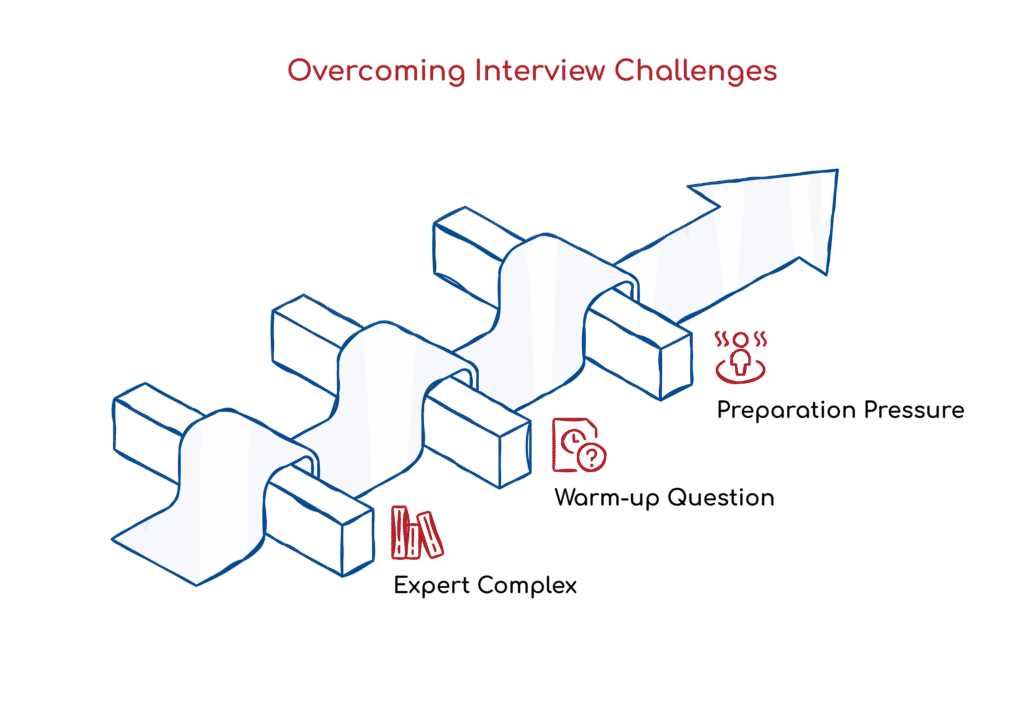
Over-scripting is a real risk. Chris experienced this firsthand in a podcast with Itai Sudan, CEO of Duda, a web development platform based just outside Boulder in Louisville, Colorado. Itai is sharp. He kept answering the next question before Chris could ask it. By the time Chris got to his prepared question, Itai had already covered it in depth. A script is a safety net, not a roadmap.
And for anyone genuinely terrified of being on camera or on a mic, here is the reframe Austin offered: think of yourself as a wingman for your audience. You are not the one who needs the information. You are in the room on behalf of everyone who needs it but cannot be there. That removes the performance pressure and replaces it with something much more manageable: curiosity on behalf of someone else.
Distribution: Why YouTube Must Be in Your Strategy
Once you have the recording, where you publish it matters enormously. The BSM team tells every client: if you are doing a podcast, it has to be on YouTube. Not just on Spotify or Apple Podcasts. YouTube. Google cites YouTube above every other social source in its AI Overviews. If your podcast is audio-only and lives only on streaming platforms, you are missing the most important distribution channel for AI search visibility.
The workflow Austin and the Digital Web Solutions team use is worth understanding. After every episode, their production team pulls the transcript, creates social clips, and posts daily content on LinkedIn and Instagram. The transcript gets repurposed into multiple formats. The core conversation becomes an evergreen asset that feeds content channels for weeks after the recording date. That is the real power of podcasting as a content strategy: one recording, distributed across every format that AI search touches.
What to Do Next
Here is the reality for most businesses. You have expertise sitting in your head that your ideal clients are actively searching for. That expertise, turned into a podcast conversation, becomes indexed content on YouTube, a transcript that AI platforms can cite, an entity authority signal that lifts your search rankings, and a content asset your team can repurpose for months. The only thing standing between you and all of that is starting.
You do not need a perfect setup. You do not need a production team. You do not need to be a polished broadcaster. You need a topic, a person worth talking to, and something like Riverside to capture it cleanly. If you want help building a content system around your expertise that feeds AI search, that is exactly what the team at BoulderSEO Marketing does. BSM Copilot takes your existing conversations, transcripts, and thought leadership and turns them into a consistent content engine. Reach out, and we’ll show you how it works.
Have an amazing Friday and a great weekend.
Stay safe and healthy,
Cheers,
The Boulder SEO Marketing Team