Hello and happy Friday! Are you doing everything right with your SEO and still getting passed over in search results? Great content, solid backlinks, optimized pages. And still, competitors show up where you should be?
The culprit might not be your content at all. It might be a technical blind spot that doesn’t get nearly enough attention: schema markup. Watch the full video above to learn more.
In this week’s Friday SEO Tip, Rose Santos, web developer here at Boulder SEO Marketing, walks through what schema markup is, why most sites are getting it wrong, and why it matters even more now that AI is reshaping how search results look.
Before we get into this week’s tip, a quick note: if you missed our April 1 AI SEO & GEO Online Summit, the recording is now available on the Chris Raulf YouTube channel. Over 800 people registered for a two-hour session covering entity optimization with Dennis Yu, CEO of BlitzMetrics, digital PR and E-E-A-T building with Josh Steimle, CEO of MWI/Canvas PR, and Brett Farmiloe, CEO of Featured/Haro, a live Micro SEO Strategies℠ demo from Daniel Burns, and GEO distribution tactics from Harold De Guzman. Watch the full summit recording here.
What Schema Markup Actually Does
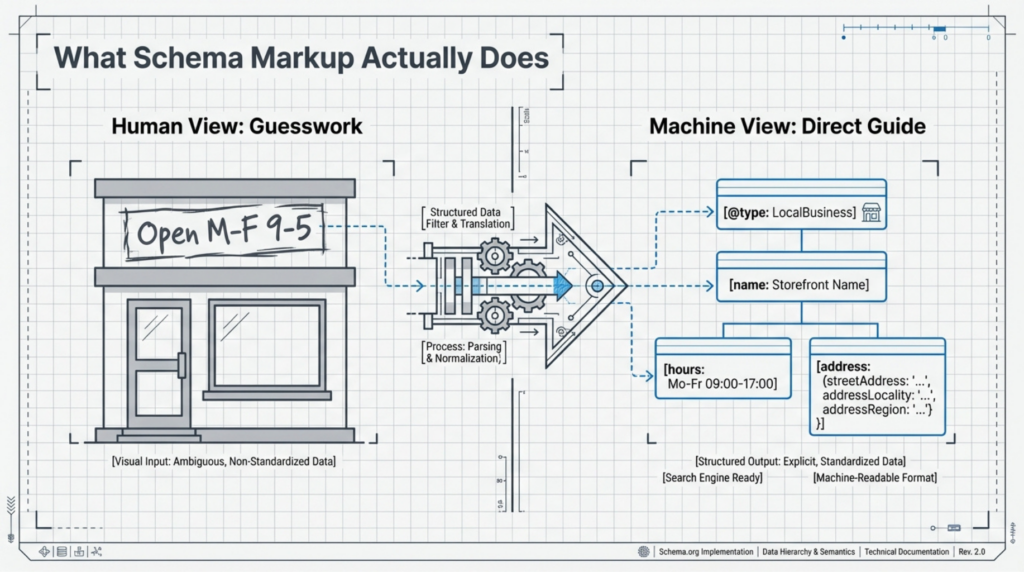
Schema markup is structured data you add to your website’s HTML. Its job is to tell search engines exactly what your content means, not just what it says. Think of it this way. If your website says “open Monday through Friday, 9 to 5,” Google can probably figure that out. But schema markup eliminates guesswork entirely. You’re giving Google a direct guide: this is a local business, here’s the address, here are the hours, here’s the phone number.
The format used here is JSON-LD, a block of structured code typically placed in the head of your HTML document. Google officially recommends it, and from a developer standpoint, it’s the cleanest approach because it sits completely separate from your visible HTML.
The payoff? Rich results. Those code snippets that make your listing stand out in search: review stars, FAQ dropdowns, product pricing, and event information. Without a schema, Google might still show your page. It just won’t stand out. For local businesses, especially, the difference in visual real estate can be significant. We work with businesses across Colorado, including plumbers, landscapers, med spas, and law firms, and those with properly implemented schema consistently occupy more space in the results than those without it. That extra visual real estate matters before anyone even clicks.
The Five Mistakes We See Every Single Week
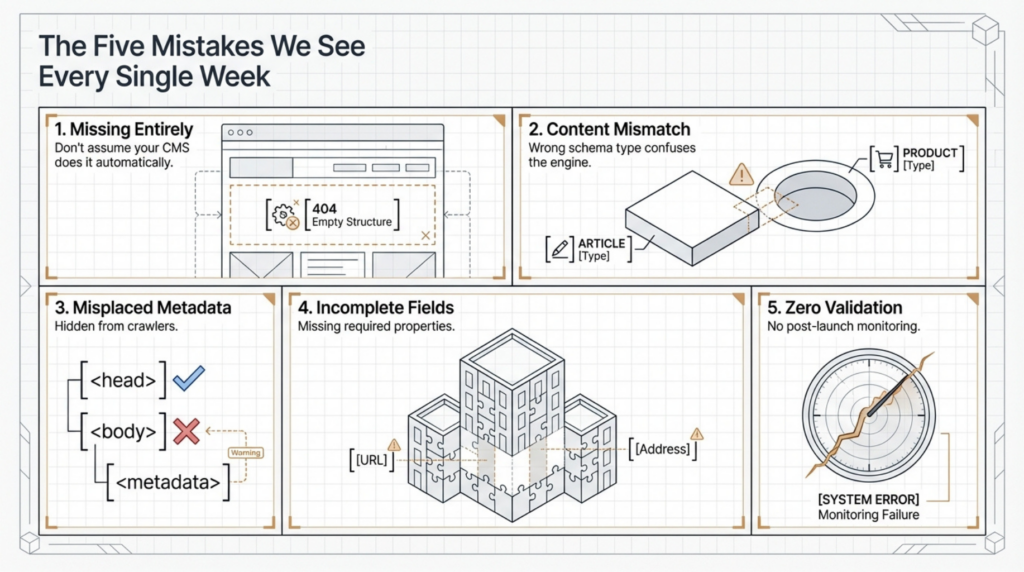
Schema has been around since 2011. And yet, every week when we audit sites, we find the same problems. Here’s what to watch for.
Missing schema entirely. Still the most common issue. Business owners assume their platform handles it. WordPress with a generic theme does not do this automatically. You need a plugin. Shopify covers only the basics, if you’re lucky. Sites built on React or Next.js almost certainly have no schema unless a developer specifically implemented it. Always verify using Google’s Rich Results Test or Schema Validator. Don’t assume.
Schema that doesn’t match the page content. A page without an FAQ section using the FAQ schema. An article page using product schema. When the schema type doesn’t match what’s actually on the page, it sends mixed signals. Article pages need an article or blog posting schema. Product pages need product schema. Service pages need a service schema. Wrong type, confused search engine.
Incorrect metadata placement. Google has confirmed that schema needs to be in the correct location in the DOM to be properly read. If your CMS or JavaScript framework injects structured data into the body instead of the head, or renders it after the page loads in a way Googlebot can’t see, your schema might as well not exist. Verify this in Search Console and with rendering tests. This connects directly to crawlability fundamentals: what Googlebot can’t access, it can’t use.
Incomplete required fields. Schema.org has required, recommended, and optional fields for each type. We see sites that implement the schema type but skip half the required fields. An organization schema with no URL. A local business with no address. A product with no name. Google won’t generate rich results from an incomplete schema, and it may flag the issue in Search Console. If you’re going to implement it, implement it properly.
No validation after implementation. You implement the schema, deploy, and move on. Three months later, you discover it’s throwing errors in Search Console because a field was formatted incorrectly. Build validation into your deployment process. Google’s Rich Results Test is free and takes about 30 seconds. Use it every time.
Why Schema Matters More Than Ever Right Now
Here’s where this gets genuinely interesting, and why we wanted to talk about schema specifically in 2026.
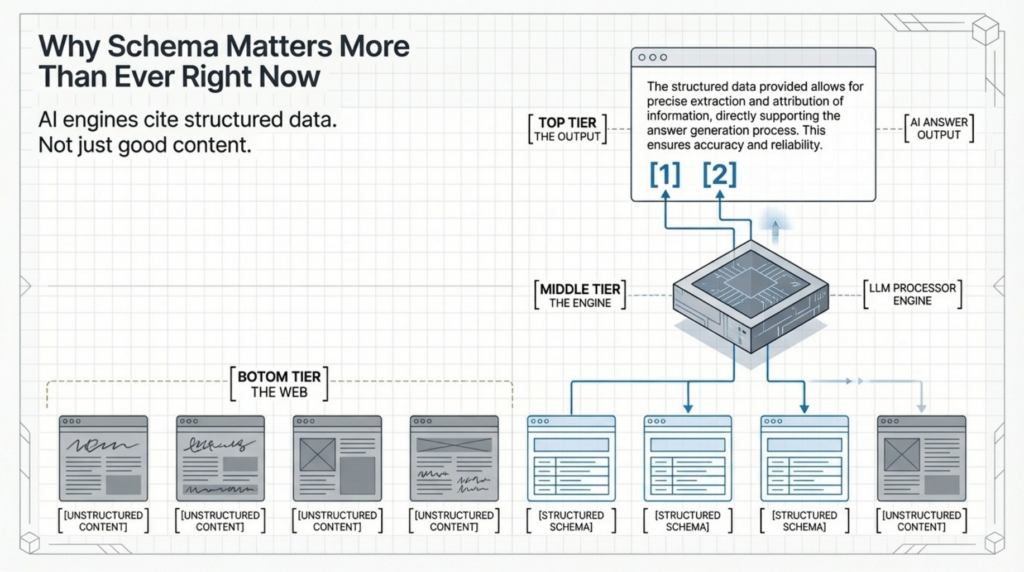
AI Overviews now appear in a significant percentage of Google search results. Perplexity, ChatGPT, Gemini. People are getting answers from AI-generated responses, not just clicking through to websites. And the businesses showing up in those AI-generated answers aren’t there by accident.
AI systems draw on structured, well-organized content. Schema markup is you telling the machine in the machine’s own language exactly what your business does, where you are, what services you offer, what your customers say about you, and why you have authority. We’ve seen AI Overviews consistently pull business hours, service areas, and reviews from local business schema when answering queries like “best plumber in Boulder.” The business with a clean, complete schema gets cited. The one without it doesn’t, even when the website content is excellent.
There’s also the local map pack angle to consider. AI Overviews are starting to replace or supplement the traditional local three-pack in some searches. The approach our team uses: include location mentions throughout relevant pages, and layer in a comprehensive local schema that reinforces what your Google Business Profile is already telling Google. They work together. Schema on your website signals the same information as your GBP, and consistency between the two is a trust signal. Mixed signals between the two, even subtle ones, create confusion that costs you visibility.
This principle is what we call Generative Engine Optimization, or GEO. Getting your content cited in AI search isn’t just about writing good content anymore. It’s about making your content structurally readable, clearly attributed, and explicitly organized so AI systems can parse it with confidence. Schema is a foundational piece of that strategy, and it connects directly to the E-E-A-T signals (Experience, Expertise, Authoritativeness, Trustworthiness) that Google and AI platforms use to evaluate whether your content is worth surfacing.
The Schema Types That Actually Move the Needle
Not all schema types are created equal. Here’s where to focus your time.
Local business schema (and subtypes) is non-negotiable for any local service business. Use the most specific subtype available. Not just “local business” but Plumber, Dental Clinic, Law Firm, Landscaping Business. The more specific, the better. This tells Google your name, address, phone number, opening hours, and service areas in a format it can read without interpretation.
FAQ schema can generate expanded FAQ dropdowns directly in search results, giving you significantly more real estate without any extra clicks. This works well on service pages and blog content where you’re already answering common questions. Just make sure the questions on the page actually match what’s in your schema. If the content and the schema don’t align, Google will ignore it or flag it as an error.
Review and aggregate rating schema puts star ratings in search results before anyone lands on your page. If you have legitimate customer reviews, surfacing them through schema is one of the fastest ways to improve click-through rate. That trust signal shows up before the first click. Four and a half stars next to your result before a visitor even lands on your page, that changes behavior.
Article and blog posting schema help Google understand publication dates, authorship, and content type. This connects directly to E-E-A-T: attributing content to a real author with a verifiable background is part of how Google evaluates content credibility. If you’re producing educational content and want it to rank, this schema type supports that effort.
Breadcrumb list schema is simple but underutilized. It tells Google your site’s navigational hierarchy and displays it in the search result URL, making it easier for users to understand where a page sits before they click. Small detail, bigger impact on perceived professionalism in the search results.
What to Do Next
Schema markup isn’t glamorous. It doesn’t get talked about as much as content strategy or link building. But it is foundational. And in an AI-driven search environment, it’s becoming a bigger factor in whether your business gets seen at all.
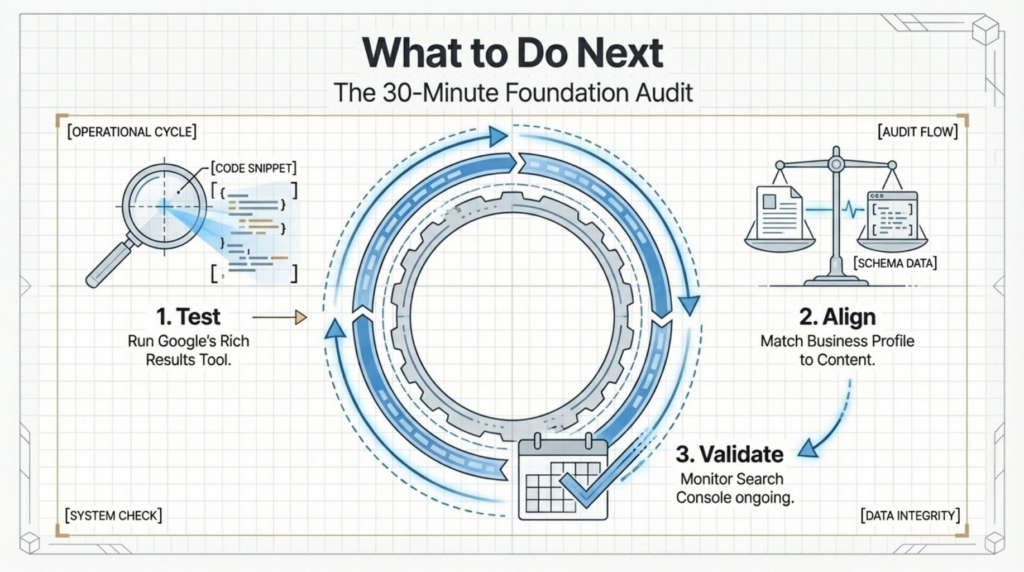
If you’ve been putting off a structured data audit, now is the time to get it done. Start with Google’s Rich Results Test and Search Console. Both are free. Check your local business schema, your FAQ schema, and make sure your metadata is landing where Google can actually read it.
One thing that catches people off guard: schema problems rarely show up in your analytics. Traffic might look stable while rich results quietly disappear or never appear at all. A properly structured data audit surfaces issues you won’t find anywhere else. It’s a 30-minute exercise that can change how your listing looks in search results for years.
The businesses winning in both traditional search and AI search have something in common: their technical foundation is clean, their content is organized and attributable, and their schema tells the same story as their content. No mixed signals, no missing fields, no outdated implementations.
If you want help with that, that’s exactly what we do at Boulder SEO Marketing. We work with local service businesses and B2B companies who want to get found on Google and in AI Overviews. Our team handles the technical side so you can focus on running your business.
Reach out to us for a free strategy session, and let’s take a look at what your structured data is actually telling search engines.
Have an amazing Friday and a great weekend.
Stay safe and healthy,
Cheers,
The Boulder SEO Marketing Team