Hello and happy Friday! Quick question to start your weekend: when was the last time you thought about whether AI crawlers can actually reach your website? Not whether people can find you. Whether the machines that now feed answers into Google, ChatGPT, Perplexity, and everything in between can crawl what you have published.
If the honest answer is “never,” you are in very good company. And this week’s tip will change how you think about it.
Watch the full video above to learn more.
We are going to be straight with you about something first. This week’s Friday SEO Tip started as a promo for an event our founder, Chris Raulf, is part of later this month. He said it himself in the video. But the data behind that event is genuinely worth five minutes of your time, even if you never register for anything. So we are going to give you the substance, and you can decide what to do with it.
Here is the number that frames everything. In February 2026 alone, AI crawlers hit websites 68 million times. That is a single month. The web these crawlers are reading is not some future scenario we are all preparing for. It is happening right now, at a scale most business owners have not stopped to picture.
68 Million Crawls in One Month. So What?
The scale is the easy part to grasp. The harder question is the one that actually matters for your business: what separates the sites AI crawlers visit from the ones they skip entirely?
That is the question a new study from Duda set out to answer. They analyzed nearly 860,000 websites, which makes this one of the largest looks at AI search visibility we have seen anywhere. Not a survey. Not a handful of case studies. Nearly 860,000 real sites were measured against whether AI crawlers were actually showing up and reading them.
Chris has been doing searches for nearly 30 years, and he called this the most rigorous data he has seen, tying what you do on your own site to whether AI names you in an answer. That is a strong statement from someone who has watched every major shift in this industry since the late 90s. When he says a study stopped him cold, it is worth paying attention.
The Finding That Stops You Cold
Here is the part that reframes the whole conversation.
Sites that AI crawlers actually visit generate 3.2 times as much human traffic as sites they skip. They pull 2.7 times more form submissions. And they see 2.5 times more click-to-call events.
Read those numbers again, because the instinct is to skim past them. More traffic. More form fills. More phone calls. Not from some separate AI channel that lives off in its own world, but tied directly to whether the crawlers can reach and read your site in the first place.
Notice what those three metrics have in common. Traffic, form submissions, and click-to-call events are not vanity numbers. They are the actions that turn into revenue. A form fill is a lead. A click-to-call is when someone dials your business. The study is not measuring whether AI likes your site in some abstract sense. It measures whether the site’s AI can read and end up with more people trying to become customers. That is a very different, and far more useful, thing to measure.
This is the moment where a lot of people have been getting the story wrong.
This Was Never AI Versus Humans
There is a fear running through a lot of business conversations right now that goes something like this: AI is going to answer everyone’s questions, so nobody will ever click through to my website, so why bother? It is a reasonable fear. It is also based on this data, backward.
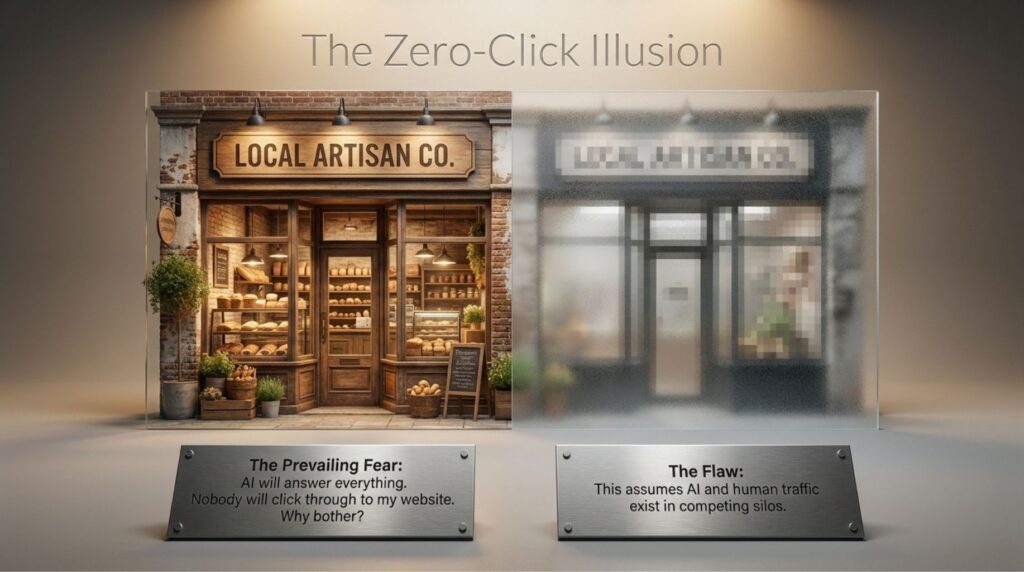
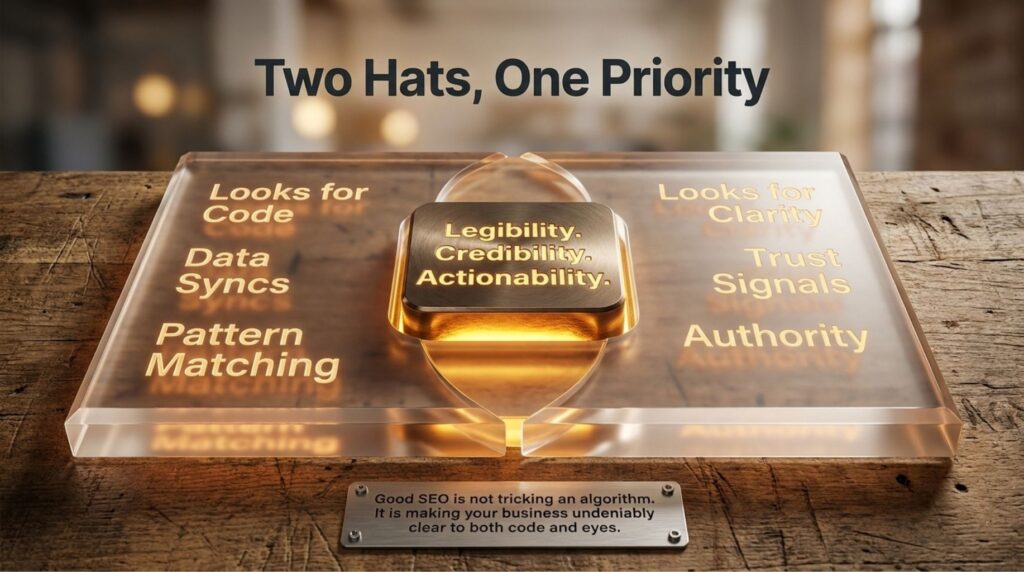
Optimizing for the machines makes your phone ring more. That is the takeaway, and it is about as simple as it gets. The same work that helps an AI crawler read your site is the work that helps a human find you, trust you, and reach out. According to the Duda study, these are not two competing priorities pulling you in different directions. They are the same priority, wearing two hats.
We tell clients a version of this constantly. Good SEO was never about tricking an algorithm. It was about making your business legible, credible, and easy to act on. AI search has not changed that. It has raised the stakes.
Think about what an AI crawler is actually trying to do. It is trying to understand who you are, what you offer, where you operate, and whether you can be trusted enough to name in an answer. A human visitor is trying to do the exact same thing, just with eyes instead of code. When you make one of them succeed, you tend to make both succeed. The work overlaps almost completely. That is why the fear of AI eating your traffic gets the causation backward: the sites that lose visibility in AI search are usually the ones that were already hard for humans to trust and act on.
So What Actually Moves the Needle?
This is where the study gets practical, and where you can stop nodding along and start doing something.
The single biggest driver was Google Business Profile sync. Sites with a synced Google Business Profile showed a 92.8 percent crawl rate. That is the highest signal in the study by a wide margin. After that came reviews, local schema markup, and blog depth. Real, published, substantive content on your site.
None of these is exotic. There is no secret tool you need to buy, no dark art you need to learn. A synced Google Business Profile. Genuine reviews. Local schema that tells search engines exactly what your business is and where it is. Blog content with actual depth to it. These are the things a small business can do, or have done, without a massive budget.
But here is what most people miss when they look at a list like that.
It Is Not One Thing. It Is the Stack.
The temptation with any list of ranking factors is to pick one, do it, and move on. This study makes a strong case against that approach.
Sites running four or more of these features got crawled at a 95.9 percent rate. Even more striking, they pulled in 16 times as many crawler visits as the average site. Not 16 percent more. Sixteen times.
The features are compound. One synced Google Business Profile helps. Adding real reviews helps more. Layer in local schema and genuine blog depth, and you are no longer a site that the crawlers occasionally notice. You are a site they come back to, again and again. The whole is dramatically bigger than the sum of the parts, and the data puts a number on exactly how much bigger.
This is why we get uneasy when someone asks us for the one trick that will fix their visibility. There usually is not one. There is a stack, and the businesses that build the stack are the ones that win.
The good news is that a stack is something you build over time, not something you have to finish in a weekend. You do not need all four or more features live by Monday to see movement. You need to start, and then keep layering. Each addition raises your crawl rate and, based on this data, your odds of showing up when someone asks an AI a question your business could answer. Progress compounds here in your favor, which is not something you can say about every part of marketing.
The One Move to Make Today
That said, if you only take one action after reading this, here it is, straight from the tip: connect your Google Business Profile and add local schema.

That is the highest-leverage, lowest-effort move in the entire study. The Google Business Profile sync was the single strongest signal at 92.8 percent, and local schema is something almost any business can implement without a developer sitting next to them for a week. Two moves. Both accessible. Both are backed by the largest dataset we have seen.
If you are a local business wondering whether any of this AI search stuff applies to you, this is your answer and your starting point. You do not need to overhaul your entire site this weekend. Go connect the profile. Add the schema. Then build from there.
Why We Think This Study Matters So Much
Step back for a second. For the last couple of years, most of the advice about AI search has been informed guesswork. Smart people making reasonable predictions about a landscape changing beneath everyone’s feet. That is not a criticism. It is just where the industry was.
What makes the Duda study different is that it takes that guesswork and grounds it in nearly 860,000 real websites. It moves the conversation from “here is what we think might work” to “here is what the data shows is working across an enormous sample.” For anyone who has to make real decisions about where to spend limited time and budget, that shift matters enormously.
It also confirms something we have believed for a long time. The fundamentals were never going away. Google Business Profile, reviews, structured data, and real content. The channels evolve, the crawlers get smarter, the answer engines multiply. But the businesses that show up as credible and easy to understand keep winning, and now there is rigorous data explaining why.
What to Do Next
Start with the two moves. Connect your Google Business Profile if it is not already synced, and add local schema to your site. Those two alone put you ahead of most of the sites in that 860,000-site sample.
If you want to go deeper, Chris is going all in on this exact topic on July 30, 2026, alongside Shawn Davis of Duda, the person who actually designed the study. It is part of Local AEO 2026, a free, nearly full-day masterclass with nine search professionals focused entirely on AI visibility. The day kicks off at 10 AM PT. If you want the full breakdown of the data straight from the source, you can register for Local AEO 2026 and join them.
And if you would rather talk through what any of this means for your specific business, that is what we are here for. We help local and national businesses get found in both traditional and AI search through Micro SEO Strategies℠, our human-driven AI-assisted approach. You can schedule a free strategy session anytime, and we will give you a straight read on where you stand.
The machines are reading the web at a scale that is hard to picture. The good news is that getting them to read you is more accessible than most people think. Start with the profile. Add the schema. Build the stack.
Have an amazing Friday and a great weekend.
Stay safe and healthy,
Cheers,
The Boulder SEO Marketing Team