Hello and happy Friday! Most local businesses have never compared the data on their Google Business Profile with what is actually on their website. We know because we audit it every week. And in 2026, that gap is now the single most common reason a local business goes from showing up in local search to going invisible overnight. Watch the full video above to learn more.
Greg Noonan, our Senior Project Manager, walked through the news side of Google’s April Maps updates. This week, our Senior SEO Strategist here at Boulder SEO Marketing, Barb Senkala, is giving you the technical side. Because the news is only half the story. The other half is understanding how Google is actually using that new enforcement infrastructure behind the scenes. And what we are seeing across client sites tells us that local SEO has quietly shifted into something fundamentally different from what it was even a year ago.
Google has moved from trust to verification. That is the shift. And it changes what you need to do this week.
What Just Changed in Google’s Local Search Model
For years, the assumption was that Google trusted the data you submitted to your Google Business Profile and used external signals to decide how much weight to give it. Submit the data, build some citations, get some reviews, and Google will generally take you at your word. That model is over.
Earlier this year, Google announced that it is now using Gemini to cross-reference suggested edits to business profiles against official web sources. Let us translate what that actually means in practice. When somebody suggests an edit to your business hours, your business name, or your category, Gemini does not just check internal Google signals. It pulls data from your website, structured directories, your schema markup, and other authoritative sources to determine whether the edit is valid.
That might sound like a small update. It is not. It is a re-architecture of how Google decides what is true about your business. And it means the technical consistency of your online presence is now directly tied to whether your listing shows up in local results and how often you appear in AI-generated answers across platforms like ChatGPT, Perplexity, and Google’s own AI Overviews.
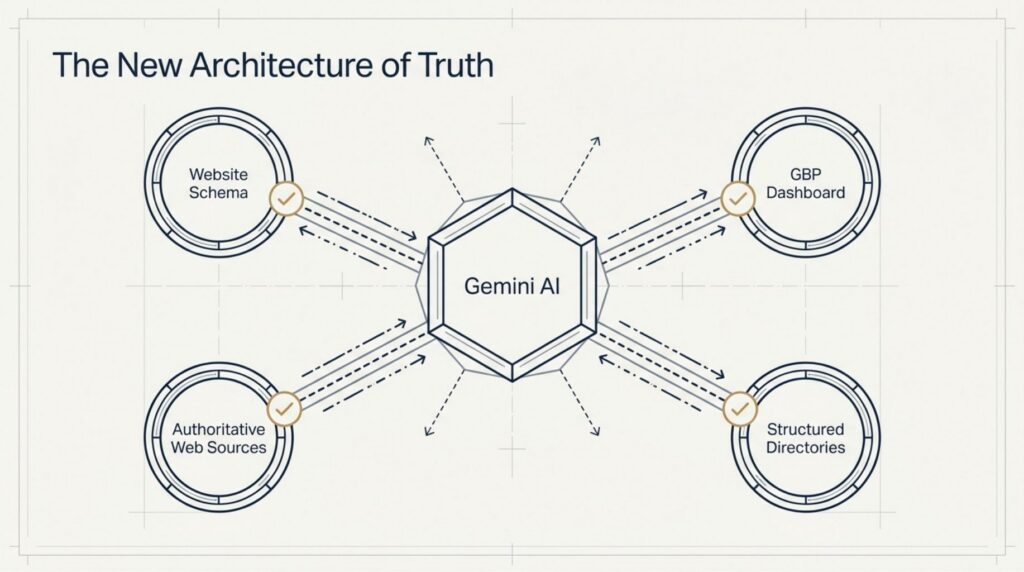
We are going to walk through the three specific signals Google is now weighing and tell you exactly how to audit each one this week.
Signal One: Your Schema Markup Now Validates Your GBP
Schema markup is the structured data you add to your website that tells Google and other search engines what your pages are about. For local businesses, the most important schema is LocalBusiness. It lets you declare your business name, address, phone number, hours, category, service area, payment methods, and more in a format search engines can read directly. No guesswork. No interpretation. Just clean, machine-readable data that confirms exactly what your business is and what it does.
Here is what changed. Before this year, schema markup was a ranking enhancement. A nice-to-have. Something that helped you qualify for rich results in the search snippets. That is no longer the whole story.
Schema is now one of the sources Gemini uses to verify whether the data on your Google Business Profile is accurate. If your GBP says you open at 7 a.m. but your LocalBusiness schema on your website says you open at 8 a.m., that discrepancy is a red flag to Google’s verification system. If your GBP category is HVAC contractor but your schema declares plumber, Google will treat your data as untrustworthy. And once trust is lowered, your visibility in the map pack starts to slide along with it.
At Boulder SEO Marketing, we have been doing schema implementations across client sites for the past six months. The pattern we are seeing in 2026 is clear. GBP verification response times are faster, and AI search visibility is materially stronger for clients with clean, complete schema on their websites. The data is self-reinforcing. Your schema validates your GBP. Your GBP validates your website. Google trusts both because they agree. The opposite is also true. When sources disagree, every signal loses weight.
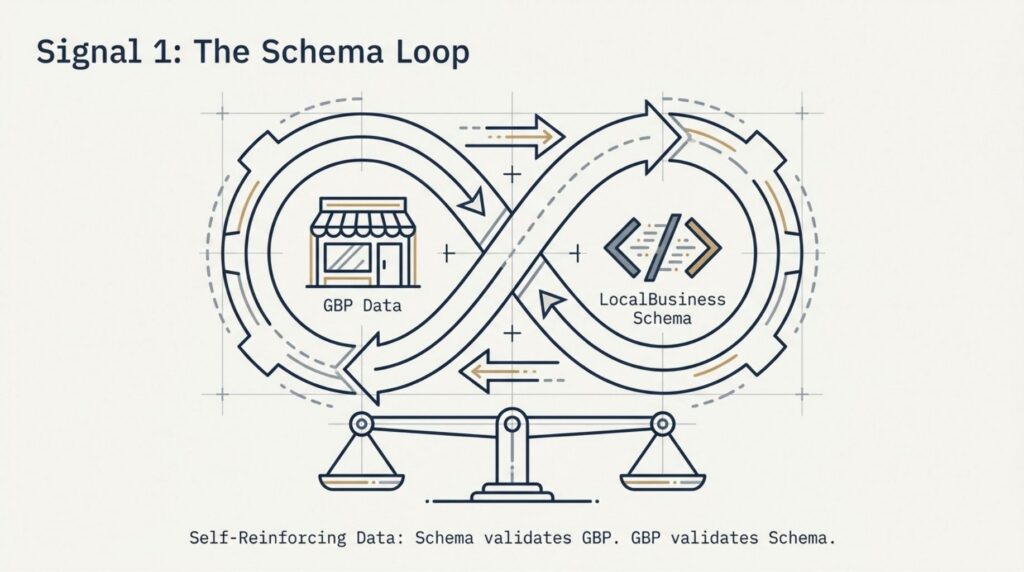
Your action this month is to run your homepage through the Google Rich Results Test. It will show you exactly what schema is currently on the page and whether Google can read it. If the LocalBusiness schema is missing, incomplete, or inconsistent with your GBP, that is your number one cleanup task this week. Then cross-reference everything against your Google Business Profile. Is the address in sync? Is the phone number in sync? Do you have the right links to your logos, hours, and categories? Just double-check and cross-check everything. Small inconsistencies at this layer compound quickly.
Signal Two: NAP Consistency Has a New Definition
NAP stands for name, address, and phone. For years, the standard advice has been to keep your NAP consistent across directories. That is true, but it is incomplete. The new standard is structured NAP consistency.
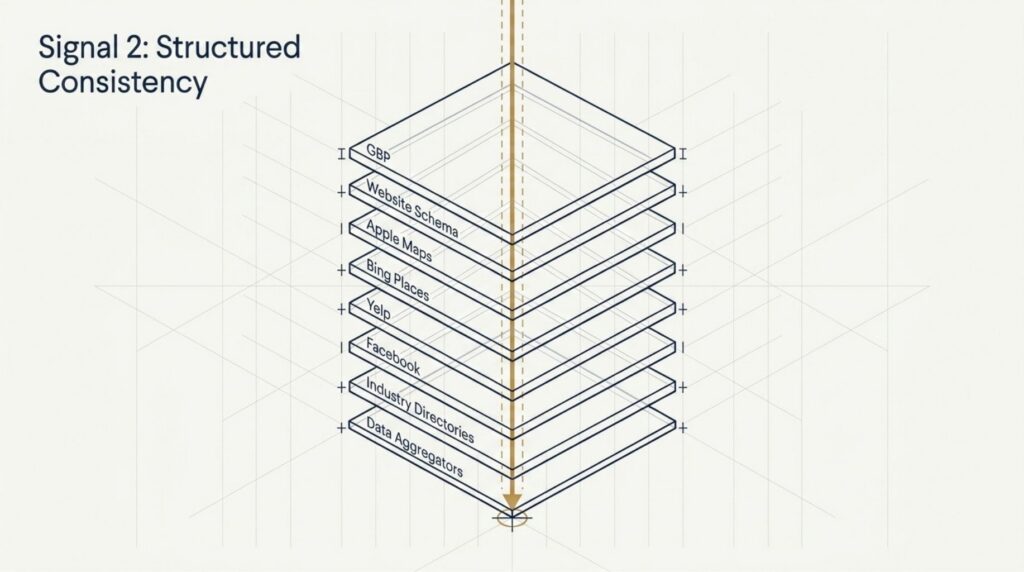
That means your NAP has to match not just across directory listings, but across every structured data source that Google can read. That includes your website schema markup, your Google Business Profile, your Bing Places listing, your Apple Maps listing, your Yelp profile, your Facebook business page, any industry-specific directories, and every place your business is listed with machine-readable data. If a search engine can parse it, Gemini can read it. And if Gemini can read it, it counts toward your verification score.
Before this year, minor inconsistencies were tolerable. Suite 100 on one listing was spelled Ste 100 on another; not a big deal. A phone number formatted with dashes on one site and parentheses on another was background noise. In 2026, those small inconsistencies start to compound because Gemini is reading all of them at once. When Gemini sees ten structured sources and seven of them agree on one version of your address while three disagree, that disagreement introduces uncertainty. In Google’s verification model, uncertainty is a negative signal. The more uncertainty, the less likely Google is to surface your business when somebody searches for what you offer nearby.
Your action this week is to run a citation audit. We use SE Ranking at Boulder SEO Marketing to pull a list of all structured sources that mention our business. We look for inconsistencies in the address field, the phone number field, the business name field, and even the website URL field. Then we fix the ones we control directly. For the few we cannot control directly, we submit corrections through the platform’s standard process.
This used to be a quarterly task. In 2026, this will need to be almost a monthly task. The audit shows you which listings are correct, which have mistakes, which are missing, and which need new submissions. Work through the list one by one and get every record into agreement. The goal is not just to have your NAP in a lot of places. The goal is to have it the same everywhere.
Signal Three: Your Website Content Must Back Your GBP Claims
This is the signal almost nobody is talking about. Your Google Business Profile has structured fields that describe your business. Services offered, areas served, business hours, appointment availability, payment methods, accessibility features. When you fill out your GBP, you pick from a dropdown of Google-defined attributes. Most businesses fill these out once during setup and never look at them again.
Here is what Google is doing now. Gemini is checking whether your website actually mentions the services you claim in your GBP attributes. If your GBP says you offer emergency service, but your website never mentions it, that is a discrepancy. If your GBP lists a wheelchair-accessible entrance but your website has zero accessibility content, that is also a discrepancy. If your GBP says you serve five surrounding cities, but your website only mentions one, Gemini sees the gap.
The practical implication is that your GBP attributes are only as strong as the website content that supports them. Claiming services you do not document is now worse than claiming fewer services that you document well. A short, accurate profile beats a long, unsupported one.
Your action this week is to log in to the Google Business Profile dashboard and export all the services, attributes, and areas served you have listed. Then open your website and do a quick search for each. Is every service you claim mentioned somewhere on the site? Does every service appear as actual page content rather than just a footer list?
If the answer is no, you have two options. Either remove the attribute from your GBP, or take the better option and add the supporting content to your website. The same goes for the attributes. Go into your profile, scroll down to your attributes, and check every accessibility item, amenity, and offering. If you say you have parking, make sure that it is mentioned on your Contact Us or location page. If you say you are wheelchair accessible, that needs to live somewhere on the site. If you say you serve Boulder, Longmont, and Lafayette, those service area mentions should appear in actual content, not just metadata.
Your Three-Step Audit for This Week
Here is how to audit yourself this week. Step one: run your homepage through the Google Rich Results Test. Confirm that your LocalBusiness schema is present, valid, and matches your Google Business Profile exactly. If the schema is missing or incomplete, that is your number one priority.
Step two: run a NAP consistency audit across your top ten structured directory listings using SE Ranking. Fix anything you control directly. For the ones you cannot control, submit corrections through the platform’s standard process. Then schedule the audit to run again next month, because this is no longer a one-and-done task.
Step three: export your GBP attributes and verify every single one is reflected in the actual website content. Remove anything you cannot support with content and add content for anything you want to keep. If a service matters to your business, write a page about it. If an area matters, mention it in content users can read.
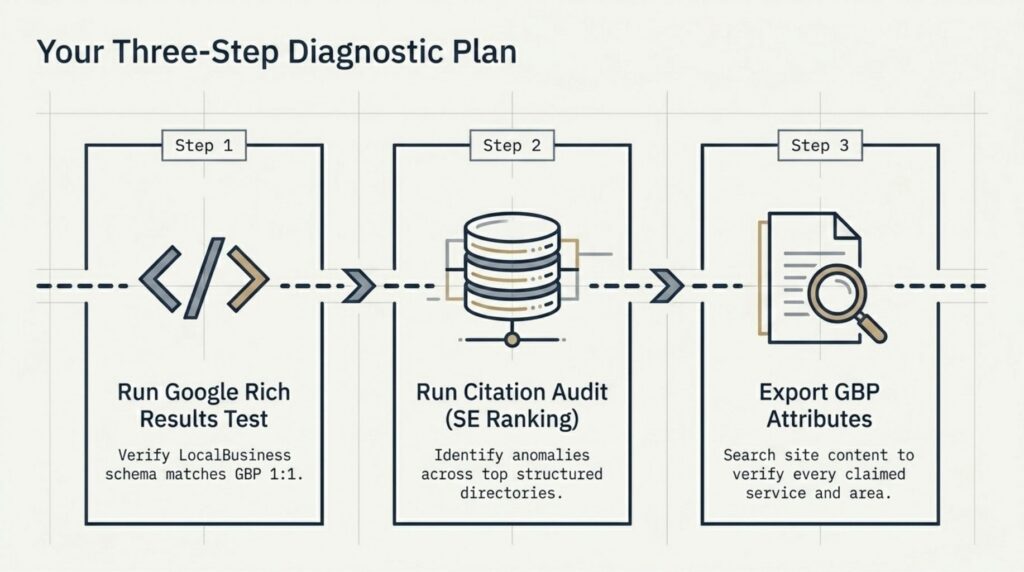
If you work through these three steps, you will be ahead of probably 90 percent of the local businesses in your market. Most businesses are still operating under the old assumption that Google trusts what they tell it. That model is obsolete. Google verifies now. Your job is to make sure every source Gemini checks tells the same story about your business.
What This Means for Local Businesses in 2026
The verification model is not going to reverse course. If anything, it will deepen. As Google continues to integrate Gemini into more parts of the Search and Maps experience, the technical consistency of your online presence will matter more, not less. And the businesses that get ahead of this now will compound their advantage over the next twelve months.
This is also why local SEO and AI search visibility are now the same problem. The same signals Gemini uses to verify your GBP are the signals other large language models use to decide whether to cite your business in an answer. Clean schema, consistent NAP, and website content that back your claims all feed into both systems simultaneously. Investing in one pays off in the other.
What to Do Next
If you would like help running the full audit on your website and Google Business Profile, we work with local service businesses every day using our Micro SEO Strategies℠ methodology. We can show you exactly where your verification gaps are and how to fix them. Reach out to the Boulder SEO Marketing team for a free strategy session.
Subscribe to the Friday SEO Tip Newsletter, and every week, we will send you one practical, actionable tip you can use the same day.
Have an amazing Friday and a great weekend.
Stay safe and healthy,
Cheers,
The Boulder SEO Marketing Team