Hello and happy Friday! Is your LinkedIn profile actually working for you? Or is it sitting there quietly, handing visibility to your competitors while you focus on everything else?
Most people set up their LinkedIn once, maybe update it when they switch jobs, and never think about it again. That’s a problem, and not for the reasons you might expect. This isn’t about getting recruited. It’s about search visibility, AI discoverability, and building the kind of entity authority that gets you cited by platforms like ChatGPT, Perplexity, and Google AI Overviews.
Watch the video above to learn more.
In this week’s tip, Jonn Chua, our Marketing Manager here at Boulder SEO Marketing, walks through the five profile sections that matter most right now and explains why each one connects directly to how Google and AI platforms understand who you are.
Your Headline Is a Keyword Field, Not Just a Label
Most people put their job title in the headline and call it done. “Marketing Manager at Boulder SEO Marketing.” Not wrong. But nowhere near what that space can do for you.
Here’s what’s actually happening behind the scenes. LinkedIn uses your headline as one of the primary signals to determine when and where your profile surfaces in search results, whether that’s inside LinkedIn itself or in a Google search. The words you put there are the words you get found for. So if you only include your title, you’ll only be found for that title.
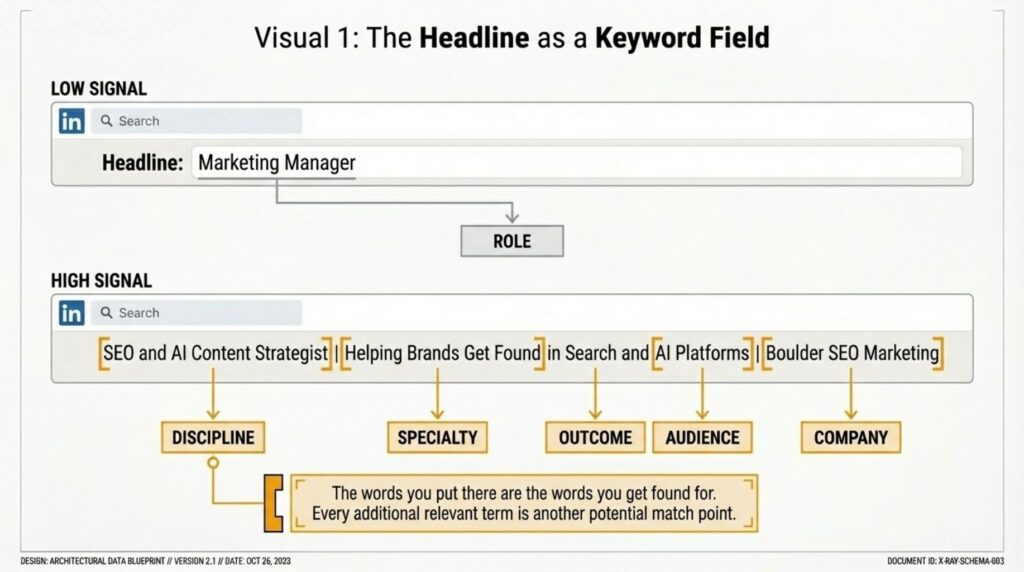
Think about what someone would actually type into a search bar to find someone who does what you do. That’s what your headline should reflect. Not your ego, not a corporate label, but the actual expertise and value you bring. Here’s a quick comparison to make this concrete. “Marketing Manager at Boulder SEO Marketing” tells a search engine one thing: your role. But “SEO and AI Content Strategist | Helping Brands Get Found in Search and AI Platforms | Boulder SEO Marketing” tells it five things: your discipline, your specialty, the outcome you deliver, the audience you serve, and the company you represent. Every additional relevant term is another potential match point when someone runs a search. Done right, your headline tells anyone who finds the profile, including any AI system pulling it, exactly what you do, what you specialize in, and who you do it with.
The First Two Lines of Your About Section Do All the Heavy Lifting
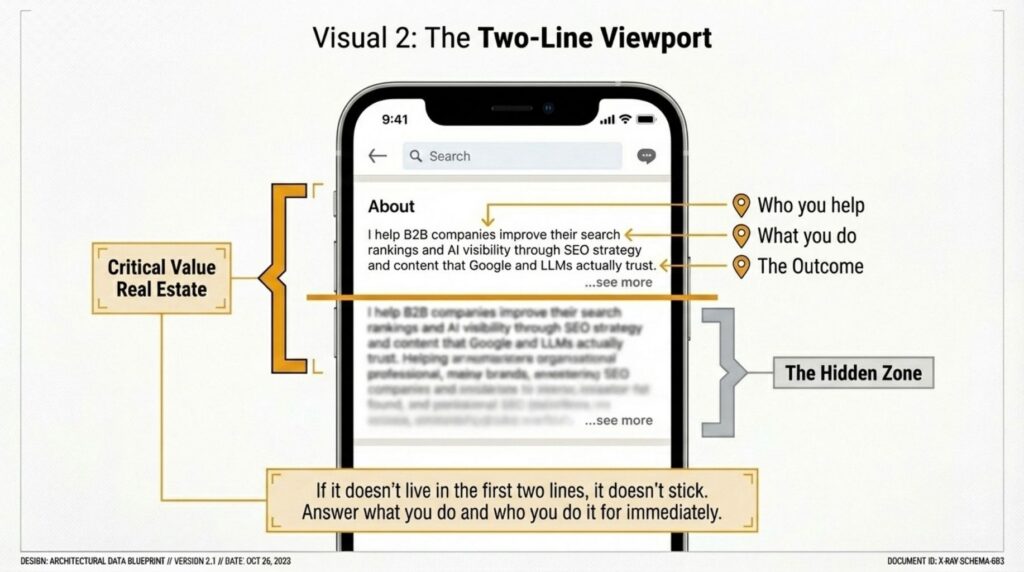
Here’s something most people don’t realize: LinkedIn cuts off your About section after the first two or three lines. Everything after that is hidden behind a “More” button. And the reality is, most visitors will never click it.
Think about how you browse LinkedIn on your phone. You see a quick preview, you make a judgment call, and you move on. That’s exactly what your visitors are doing too. So everything important needs to live in those first two lines: your keywords, your core value proposition, who you help, and what the outcome looks like.
If your About section opens with something like “I am a passionate professional with over ten years of experience,” you need to rewrite it. That sentence tells nobody anything. It doesn’t rank. It doesn’t stick. And it wastes the most valuable visible real estate on your entire profile.
Those first two lines should work hard. They should answer three questions immediately: what do you do, who do you do it for, and what happens when you do it well. Something like: “I help B2B companies improve their search rankings and AI visibility through SEO strategy and content that Google and LLMs actually trust. Marketing Manager at Boulder SEO Marketing, working at the intersection of organic search, AI platforms, and E-E-A-T.” That’s two sentences. It contains every keyword that matters. And it gives any AI system reading it a complete, unambiguous picture of what you’re about.
Your Featured Section Is the Most Underused Real Estate on LinkedIn
This is the section that most people either leave empty or fill with random posts from years ago. It should be doing something much more intentional.
The Featured section lets you pin articles, links, videos, media, and any content that represents your best work. Every link you put there sends a signal to visitors, search engines, and AI platforms: this is what this person and this company are known for.
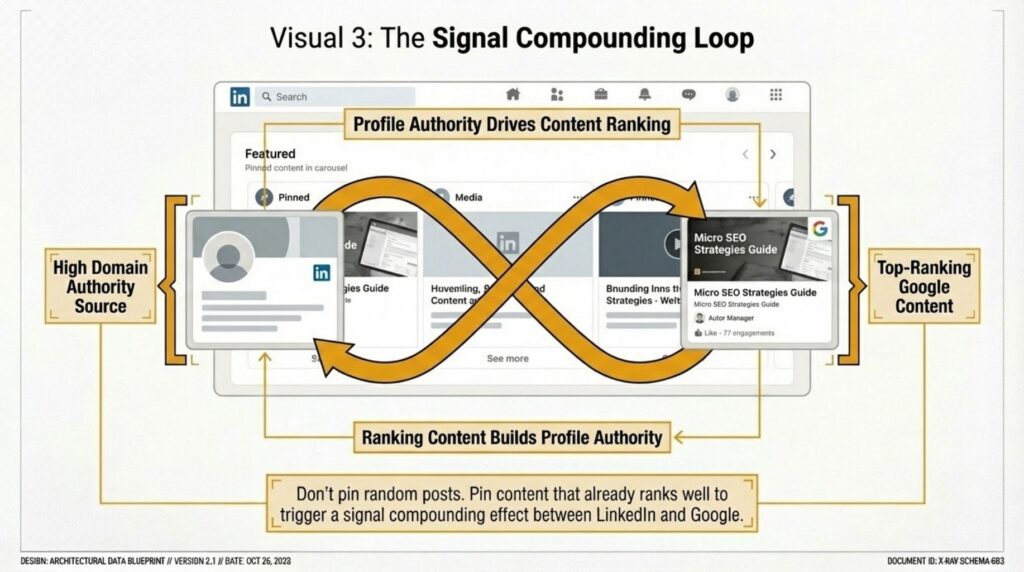
Think about what a first-time visitor experiences when they land on your profile. You have maybe thirty seconds to communicate who you are and whether they should care. Your Featured section is your chance to show them immediately. Pin the content that best tells your story. Ideally, content that already ranks well, because that creates a reinforcing loop: high-ranking content pinned to a strong profile builds more authority for both.
For context, Jonn has the Micro SEO Strategies Guide from Boulder SEO Marketing pinned to his profile. That guide ranks at the top of Google for “micro SEO.” Pairing a top-ranking piece of content with an optimized LinkedIn profile is exactly the kind of signal compounding you want to be building.
Your Experience Descriptions Tell a Story to Google and AI Platforms
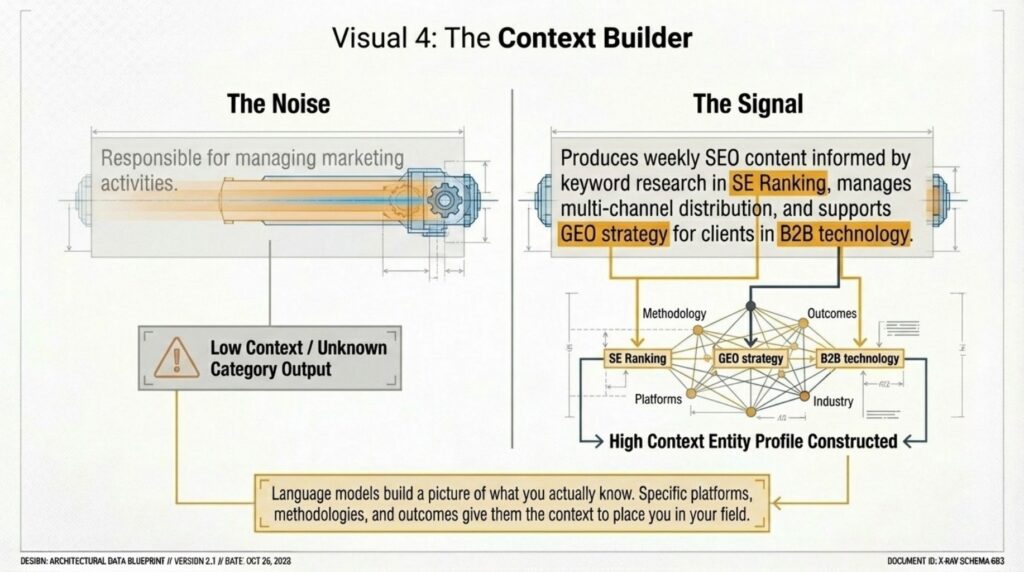
Your Experience section isn’t just a chronological list for recruiters. Google reads it. Large language models read it. And what they’re doing is building a picture of what you actually know, what you’ve actually done, and what professional category you belong to.
A description that reads “Responsible for managing marketing activities” tells them nothing. Compare that with a description that names the specific disciplines you work in, the kinds of content you produce, the tools you use, and the outcomes you’ve driven. The second version gives search engines and AI systems the context they need to accurately place you in your field.
Be specific. Use the language your audience and your industry actually use. If you work in SEO and content marketing and AI-assisted content production, say those things explicitly. Mention the platforms you use, the methodologies you apply, and the results you’ve been part of delivering. “Produces weekly SEO content informed by keyword research in SE Ranking, manages multi-channel content distribution across LinkedIn and email, and supports GEO strategy for clients in home services, professional services, and B2B technology sectors.” That one sentence is more informative to a search engine or LLM than three paragraphs of vague responsibility language. That specificity is exactly what makes a profile readable and rankable by both humans and machines.
Your Skills List Is Still Sending Signals Whether You’ve Touched It or Not
Most people treat the Skills section like an afterthought. You added a bunch of skills when you first created your profile, maybe got a few endorsements, and never touched it again. But here’s what’s happening in the background: LinkedIn uses your skills to categorize what kind of professional you are and decide who to surface your profile to. And large language models use them as additional data points when they’re trying to understand your expertise.
If your skills list is outdated, full of things you no longer do, or just generic enough to apply to anyone, you’re sending mixed signals. You’re essentially asking LinkedIn and AI systems to figure out who you are without giving them anything useful to work with.
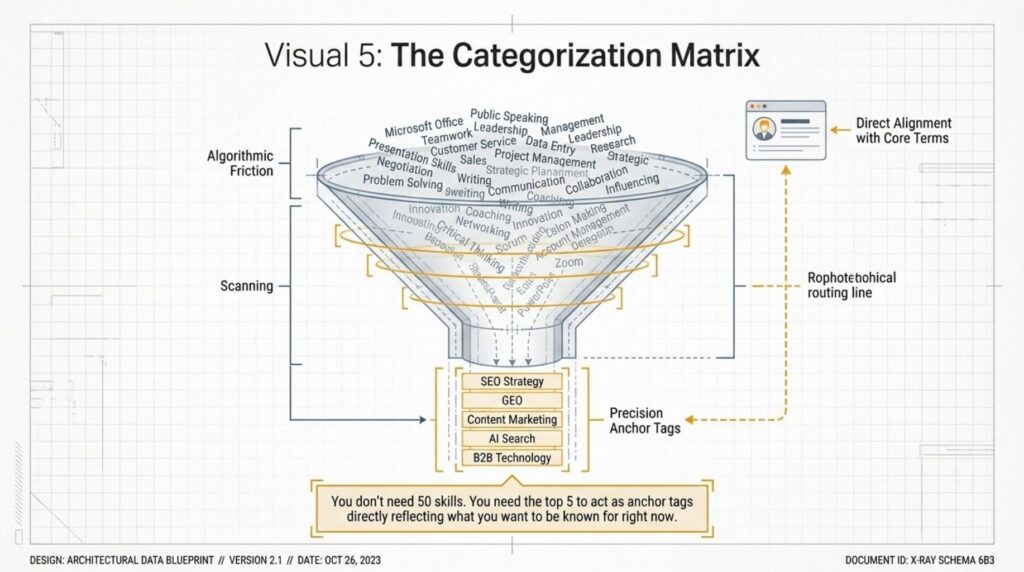
LinkedIn lets you list up to 50 skills. You don’t need 50. You need the right ones. The key is making sure your top five skills directly reflect what you want to be known for right now, not what you were doing three years ago. Keep it current. Keep it aligned. And make sure those skills match what’s in your headline, your About section, and your Experience descriptions. That consistency across profile sections is itself a trust signal. We’ll come back to that in a moment.
The Consistency Signal That Most People Miss
Here’s something that doesn’t get talked about nearly enough. It’s not just about optimizing each of these five sections individually. It’s about what happens when they all say the same thing.
Google and large language models are pattern-matching systems. When your headline says “SEO Strategist,” your About section opens with a sentence about improving search visibility, your Experience descriptions mention keyword research and content optimization, and your Skills list includes SEO, content marketing, and GEO. Those systems receive a consistent, coherent signal. Every data point confirms the same core identity, and that confirmation is what builds confidence in the entity profile they’re constructing around you.
On the flip side, a headline that says “Digital Marketing Expert,” an About section that’s mostly about your professional journey, Experience descriptions full of soft skills and vague responsibilities, and a Skills list that includes everything from Microsoft Office to public speaking? Those systems get noise. The entity picture is blurry. And a blurry entity is one that doesn’t get cited, doesn’t get recommended, and doesn’t show up when it should.
Think of it this way: each of those five sections is a witness. If all five witnesses tell the same story about who you are and what you’re known for, the algorithm believes them. If they all tell different stories, the algorithm discounts them all. Consistency isn’t a nice-to-have. It’s the mechanism that makes everything else work.
Why All of This Matters Beyond a Cleaner Profile
Here’s where this goes deeper than just profile optimization hygiene.
LinkedIn has enormous domain authority. For those not familiar with the term, domain authority is a measure of how much Google trusts a given website, and LinkedIn’s score is about as high as it gets. What that means practically is that well-optimized content published through a well-optimized profile can rank in Google fast. Sometimes within 24 hours.
Chris, our founder at Boulder SEO Marketing, published a comprehensive first-person travel guide on LinkedIn, a detailed piece about his trip to Kilimanjaro, the Serengeti, and Zanzibar, on a Sunday. By Monday morning, it was already ranking at number one in Google, above dedicated travel websites. That’s what happens when you combine authentic first-person content with a high-authority platform and a profile that’s been built up with real signals.
And here’s an angle most people don’t think about. The authority of your LinkedIn profile itself can be increased through backlinks. In the same way a website earns domain authority through inbound links from high-DA sources, your LinkedIn profile earns authority the same way. Building high-quality backlinks to your LinkedIn profile from credible publications makes it a stronger ranking platform. One approach that works well is contributing to publications through platforms like Featured.com, which can result in backlinks pointing directly to your LinkedIn profile from high-authority domains. More authority on the profile means content you publish through it ranks faster and holds longer.
Now layer on the AI angle. When someone types a question into ChatGPT or Perplexity, asking who the best SEO expert in Denver is or what Boulder SEO Marketing specializes in, those AI platforms aren’t pulling from one source. They’re aggregating information from multiple places across the web and building a picture of who you are. That process is essentially what we mean when we say AI platforms are constructing an entity profile. Your LinkedIn profile is one of the first places those systems look. So the cleaner, more consistent, and more keyword-rich your profile is, the more accurate and complete that picture becomes.
This is exactly why earlier this year, we put the entire Boulder SEO Marketing team through a LinkedIn optimization training. Not for recruiting purposes. For E-E-A-T. Every team member’s profile is a signal that feeds into how AI platforms understand and represent our agency. A whole team of optimized profiles, all connected to the same company, all clearly signaling expertise in the same area, that’s how you build the kind of entity authority that gets you cited in AI Overviews consistently.

What to Do Next
Five sections. One afternoon. That’s genuinely all it takes to be ahead of most profiles on the platform.
Start with your headline. Then fix those first two lines of your About section. Pin your best content to your Featured section. Update your Experience descriptions to actually say something meaningful. And clean up your Skills list so it reflects where you are now.
One practical note: as you go through each section, keep a running list of the three to five core terms you want to be known for. Those terms should show up, naturally and consistently, in every section you touch. That’s the consistency signal doing its job.
If you’re a business owner or team leader, don’t stop at your own profile. Get your team to do it too. Because collectively, those profiles form part of your company’s authority signal to Google and AI platforms. Each optimized profile connected to your company is another data point feeding into your entity score. And in the search and AI landscape right now, that adds up.
Want to go deeper on the GEO and AI search side of this, specifically, how to build entity authority and get cited by AI platforms consistently? Subscribe to our newsletter. We drop new tips every Friday.
Have an amazing Friday and a great weekend.
Stay safe and healthy,
Cheers,
The Boulder SEO Marketing Team