Hello and happy Friday! Have you ever stopped to ask yourself whether the SEO tactics that look great on a quarterly report are quietly building risk into your business that won’t show up until the moment you try to sell, scale, or recover from a Google update?
This week we’re doing something a bit different. Our Founder Chris Raulf sat down with Jean-Charles “Jason” Dervieux, founder of Scaling Law Firms and a former Boulder SEO Marketing client, for a Friday SEO Tip podcast edition. Jason now operates as a fractional chief growth officer inside law firms in the 2.5 to 45 million dollar range. The conversation went on for almost an hour because every topic Jason raised maps to patterns we’re seeing across the entire legal vertical and, honestly, across most multi-location service businesses. Watch the full video above to learn more.
It’s a real conversation between two people who care about doing this work the right way. We pulled out the moments we think matter most for any business owner considering scale, brand equity, and AI search visibility right now.
What Hidden SEO Risk Looks Like When You’re Scaling Locations
Jason walked through one of the more aggressive plays some agencies are running on multi-location law firms right now. They charge around 1,000 dollars per Google Business Profile location. They sign cheap leases on tiny offices, sometimes for as little as $200 to $700 a month, just to satisfy address requirements. Then they pump those locations full of webinar-review responses, where the “review” is feedback on a webinar the visitor watched, not on a real client experience. The whole thing is sold as fully aligned with Google’s policy. It is not.
It works. Until it doesn’t.
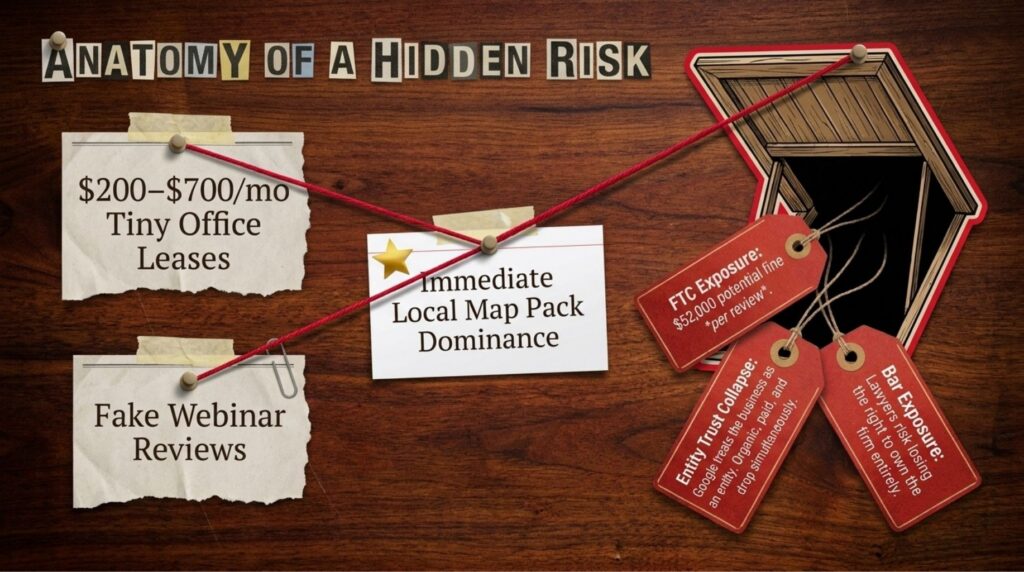
Jason cited FTC research showing a potential 52,000 dollar fine per fake review if a competitor or anyone else files a complaint. That’s per review. Then there’s the bar exposure for lawyers, which can include losing the right to own the firm at all. Google itself now treats businesses as entities, not as separate channels. When trust breaks in one channel, the impact can spread to organic search, paid search, and the map pack simultaneously. Chris pointed out that we covered Google’s global crackdown on inauthentic reviews in last week’s Friday SEO Tip, and the writing has been on the wall for a while now.
Here’s our take. If a tactic only works because Google hasn’t caught it yet, it isn’t a strategy. It’s a short window of borrowed time. Jason’s framing of “fragility” is the right word. The damage is invisible until it isn’t. The diagnostic he recommended is straightforward. List every active SEO tactic. Ask whether it aligns with Google’s core goal of serving the best possible result to the searcher. If not, the clock is already ticking.
Why Naming Your Business Is an Economic Decision
Jason opened his guide on law firm naming with a line that stopped Chris cold: most law firms make their naming decision in the first 90 days of formation, and it becomes a permanent constraint at the moment of greatest economic significance. That applies to a lot more than law firms.
When you name a business after yourself, you become the brand. Your reputation is the asset. That works for some founders. It also caps your exit value because the brand equity walks out the door the moment you do. Jason used Modern Family Law as a counterexample. Nobody knows who owns it. The brand is the brand. It scales across state lines, lowers cost per acquisition, and the company is sellable because the equity isn’t tied to a single human being.
The other end of the spectrum is the law firm Jason mentioned, Morgan & Morgan, which is now generating 1.5 billion dollars a year. Their tagline, “for the people,” is drilled into every billboard, every commercial, every channel. That kind of consistency over the years is what builds true brand equity. Most of the firms Jason audits show the opposite pattern. The website tells one story, the ads tell another, the social presence tells a third. The lack of congruency erodes trust before any algorithm gets involved.
The smaller version of this same principle: think about your domain, your trademark alignment, and how your name shows up across AI search platforms before you commit. We see this all the time when we audit new clients. The naming decision was made in the second week of starting the business. The economic consequences are showing up in year ten.
What Virtual Client Architecture Means for Your Brand’s Future
Chris brought up the work we now do with every client, what we call virtual client architecture. Every client gets a digital twin. Virtual Mark, Virtual Tom, Virtual Irina, or a virtual version of the brand itself. The point isn’t novelty. The point is institutionalizing knowledge so it doesn’t walk out the door with one person, and so the brand has a way to keep producing on-voice content even when the founder isn’t on every call, every webinar, every podcast.

Jason’s reaction was honest. He said the reality of an acquisition for founder-led firms is usually a 1-to-3-year earn-out, where the founder stays on to transition the brand off themselves. AI changes the math on that. If the founder’s voice, expertise, and decision patterns can be preserved digitally, the brand becomes less dependent on the human and more dependent on the system. That’s a real shift in how exit value gets calculated.
Whether or not you’re thinking about an exit, this matters. Every podcast, every conference talk, every internal training session is data your team should be capturing and feeding into something. Not to replace the founder. To make the founder’s expertise distributable across the team and across every channel where the brand needs to show up.
The Search Everywhere Reality and the 70 Percent Zero-Click Projection
We’ve been saying for a while that ranking in one search engine isn’t the work anymore. Jason quoted Nathan Gotch’s framing: SEO is now search everywhere optimization, and that’s right. The job is making sure you’re cited across an entire ecosystem. ChatGPT, Claude, Perplexity, Gemini, Google AI Overviews, traditional Google, the map pack, and the directory and review sites that feed them all.
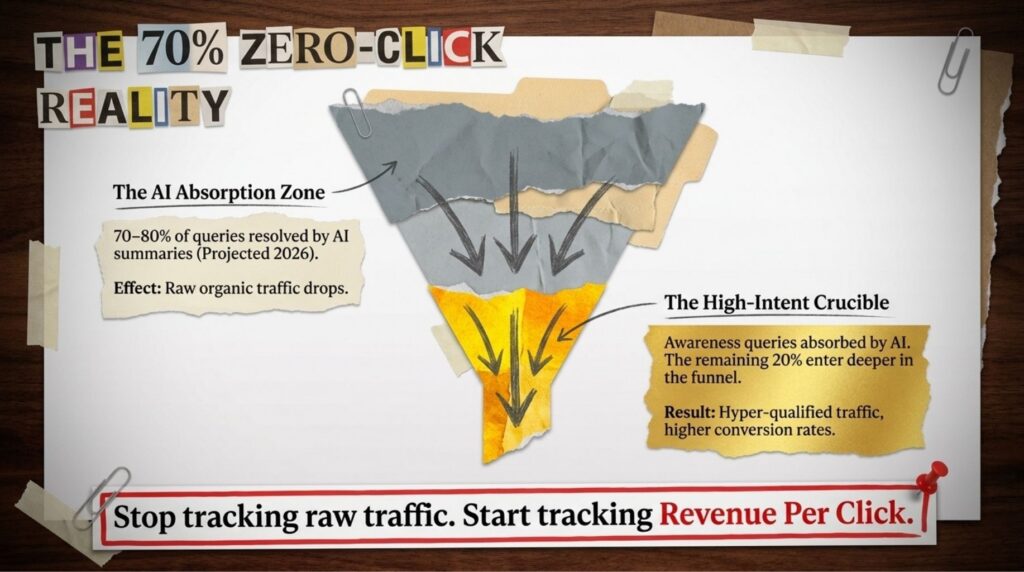
Jason’s guide includes a stat that should make every legal marketer pause: 70 to 80 percent of legal queries are projected to be zero-click by the end of 2026. That means the user gets their answer in the AI summary without ever visiting a website. The same trend is showing up in finance, healthcare, real estate, and most other service categories.
Here’s what most people miss in that data. Yes, traffic goes down. But conversion rates on the traffic you do get tend to go up because the awareness-stage queries are getting absorbed by AI, and the people clicking through to your site are deeper in the funnel. Less traffic. More qualified traffic. More revenue per click. Chris shared a recent example: of the four sales calls last Friday, three of the leads found us on ChatGPT, Claude, or Perplexity. Only one came through traditional Google. That ratio is the conversation. It’s also why we keep telling clients that obsessing over raw organic traffic numbers is the wrong scoreboard right now.
Why Authority Is the Ranking Signal That Actually Scales
Jason’s framing on this was simple. Authority is the foundation. Everything else is a tactic that either reinforces authority or quietly erodes it. The two ranking signals that matter most across both traditional Google and AI search are website authority and the E-E-A-T score of the actual person behind the content. Experience, expertise, authoritativeness, trustworthiness.
We see the gap in audits every week. Blog posts with no author attribution. Generic content that could have been written by anyone. No author bio pages. No depth of expertise visible on the site. None of the signals that AI platforms use to decide whether your business is worth citing when someone asks for a recommendation.
The fix isn’t fancy. Real author bios. First-hand experience in the content itself. Distribution of that authority across LinkedIn, podcasts, conference appearances, directory profiles, and review platforms. We call this approach part of our Micro SEO Strategies℠ methodology because the moves are small individually and compound into authority signals that AI platforms can validate.
How to Pressure-Test Your Own SEO Setup This Quarter
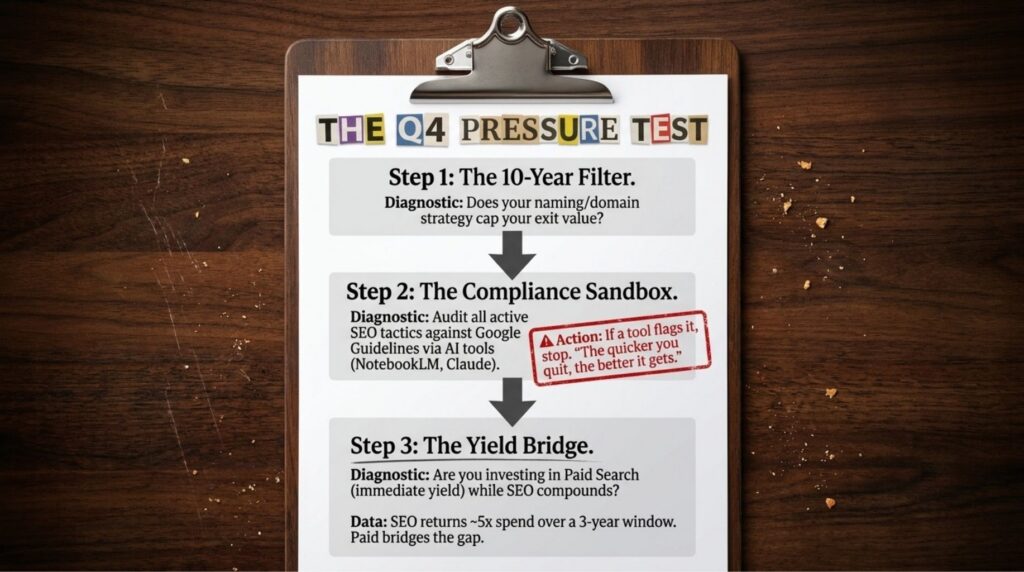
Jason gave a quick three-move framework for founders running businesses in the $1 to $50 million range who want to get their house in order. We’d add a few of our own filters on top.
First, write down your 10-year vision and let it drive your naming, domain, trademark, and brand architecture strategy. If your vision involves selling, naming the business after yourself is probably the wrong call. If your vision is to become the recognized expert in your category, it might be exactly right. The decision should be deliberate, not default.
Second, audit every active SEO tactic against Google’s stated guidelines. If you’re not sure whether a tactic crosses the line, run it through Gemini, Claude, or ChatGPT with the policy documents in context, the way Jason described using NotebookLM as a compliance sandbox. If the tool flags it, stop doing it. The “quicker you quit, the better it gets” principle Jason borrowed from quitting smoking applies here. The longer you let fragility compound, the harder it is to unwind.
Third, invest in paid search while SEO compounds. Jason cited the legal industry data showing that money invested in SEO returns roughly five times the spend over a three-year window. We see similar patterns across the verticals we work in. SEO is the gift that keeps on giving, but it isn’t fast. Paid bridges the gap.
And finally, get serious about authority. Author bios. Real first-hand content. Visibility across multiple platforms. Track which AI platforms are actually citing you and which ones aren’t, even if the tracking is imperfect right now. We use SE Ranking and a few other tools, and we’d be the first to tell you the AI search tracking layer is still maturing across the industry. Jason mentioned a 615 times difference in citation behavior between Grok and Claude on the same brand, which gives you a sense of how much variance is in the system right now.
What to Do Next
If you’re scaling a multi-location business and you’re not sure whether your current SEO setup is building real authority or quietly creating fragility, that’s the audit to run this quarter. Pull every tactic into the light. Map the trust signals. Decide what you’re actually building.
If you’d like a second set of eyes, book a free strategy session with our team. We’ll walk through your current setup, point out the structural risks we see, and tell you honestly whether you need to bring in an agency or whether you have what you need to fix it internally. Either way, you’ll leave the call with clarity.
If you have a guest you think we should have on a future Friday SEO Tip podcast edition, send us a note. The Jason conversation reminded us that some of the best teaching moments happen when two operators are just talking through what they’re seeing on the ground.
Have an amazing Friday and a great weekend.
Stay safe and healthy,
Cheers,
The Boulder SEO Marketing Team