Hello and happy Friday! When was the last time you took a real inventory of every page on your website? If your answer is “not recently” or “never,” you are not alone, and you are almost certainly sitting on sleeping giants. These are pages that rank for dozens of keywords, pull in thousands of impressions, and still generate almost no clicks for your business. The good news? Once you know what to look for, sleeping giants are one of the fastest paths to more leads and sales from organic search, because the hardest part (earning ranking authority) is already done. Watch the full video above to learn more.
In this week’s Friday SEO Tip, Chris Raulf, our founder here at Boulder SEO Marketing, walks through his exact process for identifying sleeping giant pages using Google Search Console, why these pages fail to convert impressions into clicks, and the content fix that turns them into real traffic and lead generators. Let’s get into it.
Why Organic Search Still Drives the Cheapest, Highest-Quality Leads
To survive and thrive in today’s hyper-competitive landscape, local service businesses need a steady flow of leads and sales. There are plenty of ways to generate that demand, such as email marketing, pay-per-click, social media, and paid ads on every platform under the sun. Historically, the least expensive and most effective way to generate leads is through organic search engine optimization. Paid channels work, but the moment you stop paying, the leads stop coming in. Organic pages continue to produce results for months and years after the work is done.
Here is the reality we see with clients every single day. Many local service businesses are genuinely great at what they do. They are skilled, experienced, and often have years of happy customers behind them. What they struggle with is getting to page one of Google for the searches that matter. Their best pages are either buried on page two, three, or further back, or they are ranking on page one and two but not getting clicked.
That second scenario is the one we want to talk about today, because it is the hidden opportunity almost nobody is working on. If you are willing to spend a few hours auditing your own website this summer, you can find pages that are already doing most of the heavy lifting and turn them into your top lead drivers. You are not starting from zero. You are unlocking pages Google already trusts.
The Sleeping Giant Problem Most Business Owners Never See
Business owners are busy. Pages get created, posted, updated, and forgotten. More pages get added on top. Old webinar dates and expired offers sit there for years. Content that used to be sharp grows stale. Tools get replaced, pricing changes, and team members come and go. The site keeps growing, but nobody is looking at the bigger picture.
Our recommendation, and what Chris is doing for the entire Boulder SEO Marketing website this summer, is to take a full inventory of your site at least once a year. Build a simple Google Doc or spreadsheet, list every page, and ask the same question for each one. Is the content still accurate? Are the dates current? Are the links and tools referenced still the right ones? Is this page pulling its weight? This exercise is a multi-month project for most businesses, and it is worth every minute. You will find pages that should be deleted, pages that should be merged, and most importantly, pages that should be rebuilt because they are almost there.
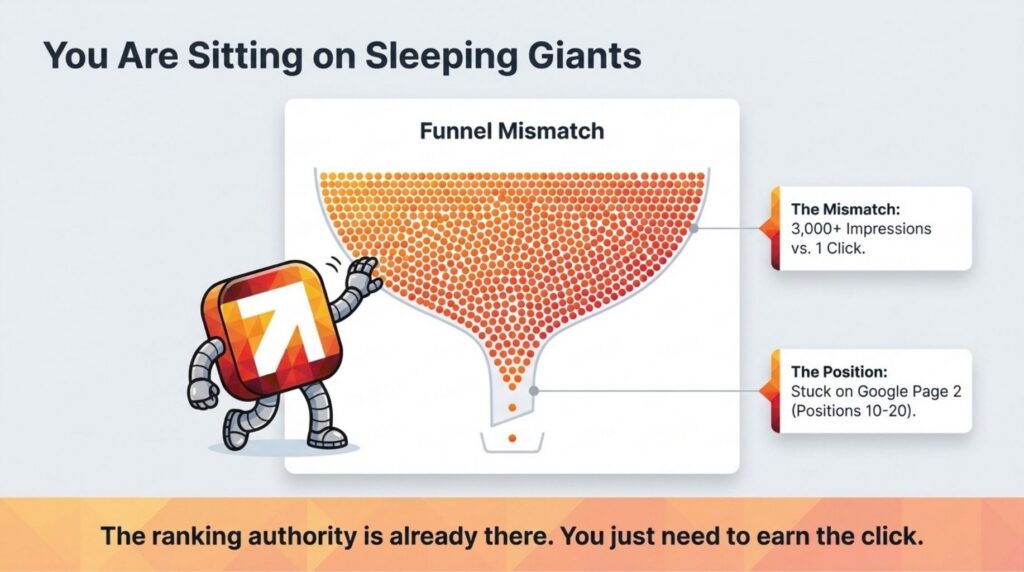
As you go through that inventory, a specific type of page will start to stand out. Pages that get a lot of impressions, very few clicks, and sit somewhere between position 10 and 20 in Google. Those are your sleeping giants, and they are the ones you want to wake up first, because the ranking authority is already there. All that is left is to fix the content so it actually earns the click.
How to Find a Sleeping Giant in Google Search Console
For this, you only need one free tool, and every website owner already has access to it. Google Search Console. If you do not have it set up for your website, stop reading and go set it up. It is the single most valuable free tool Google offers, and it will tell you exactly which of your pages are close to breaking through and which ones are not being seen at all.
Here is exactly what Chris did to find the sleeping giant he talks about in this week’s tip. He pulled 28-day data from Google Search Console and scanned the list of pages, specifically looking for pages that were getting strong impressions with low clicks. One page stood out right away: our own guide on finding the right local SEO keywords. The page was over a year old, had been published quickly without much depth, and was ranking for a surprisingly wide range of queries.
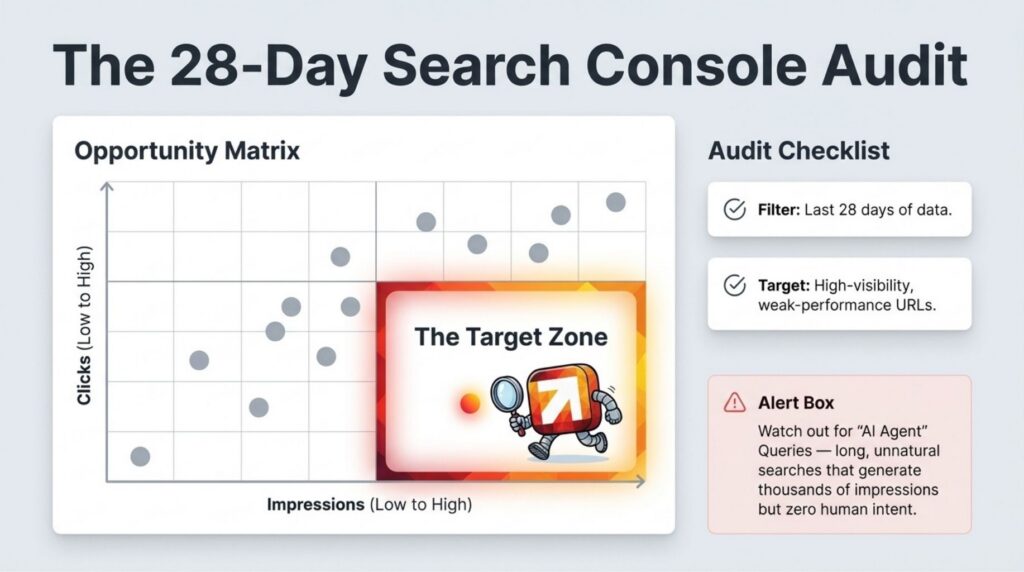
He then added that URL to the Search Console page filter and reviewed the last seven days of data. The numbers told the story immediately. Over 3,000 impressions. One click. Average position around 13. That mismatch is the tell. Strong visibility, weak performance, and a ranking position that says Google takes the page seriously but is not quite ready to give it the top spots. If you see that pattern anywhere on your site, stop scrolling and flag that URL. You just found a sleeping giant.
When he drilled into the query list, something even more interesting showed up. Dozens of extremely long, unnatural-looking search terms that no human would ever actually type. Queries written in a way that screams AI-generated search behavior, likely coming from AI agents or tools running searches on behalf of real users. Even more interesting, the page was appearing within the AI Overview for some of these queries. So the ranking data looks great on paper, but the real human click volume is almost zero.
Why the Page Ranks for Everything and Converts for Nothing
This is where the analysis gets really useful. Chris took the Search Console data into Virtual Chris on Claude and worked through the pattern. The conclusion was clear. The page has genuine authority. Its keyword footprint is massive. It ranks in the top three for dozens of long-tail queries. But none of that is translating into clicks, and it came down to two specific issues.
First, most of those long-tail queries are AI-generated searches that were never going to produce a human click. The impressions are real, but the click intent is not. You can rank for five hundred of these and still see a single click on a good week. They are machines talking to machines.
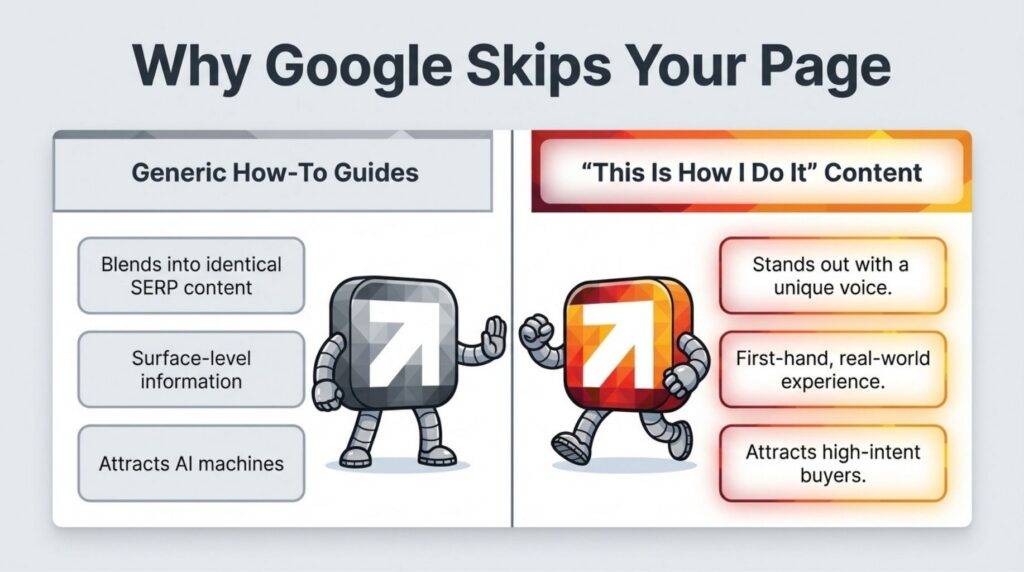
Second, and this is the bigger problem, the page is a generic how-to guide in a world drowning in them. When a real human searches for something like “local keyword research,” they land in a SERP full of nearly identical content. Ours does not stand out. It does not say “this is exactly how I do it.” It does not show process, voice, or first-hand experience. It reads like every other intro-level SEO article on the internet, which means Google has no compelling reason to hand us the click over anyone else.
That is the sleeping giant in plain language. The authority is real. The footprint is massive. The opportunity is enormous. But the content itself isn’t pulling its weight, so Google hands the clicks to whoever does a better job of actually showing up for high-intent, shorter-tail keywords. The page is one rewrite away from being a true lead generator.
How to Wake Up a Sleeping Giant the Right Way
This is where the fix comes in. The strategy we recommend, and the one Chris is applying to that local keyword research page right now, is the Universal Content Engine. Chris just presented this methodology at a conference in Germany, and the full write-up is published on his personal site with every prompt, every step, and every piece of source material you need to run it yourself. No gatekeeping. The whole process is there.
The short version of what you are doing is this. You take the sleeping giant page, identify the high-intent short-tail keywords you actually want to rank for, and rebuild the content as a “this is how I do it” piece that is genuinely the best on the internet for those terms. You ground it in first-hand experience from a real expert inside your business. You use AI to accelerate research, structure, and drafting, but the voice, expertise, and examples come from a human who actually lives this work every day. That is the Micro SEO Strategies℠ approach in a nutshell. Human-driven, AI-assisted.
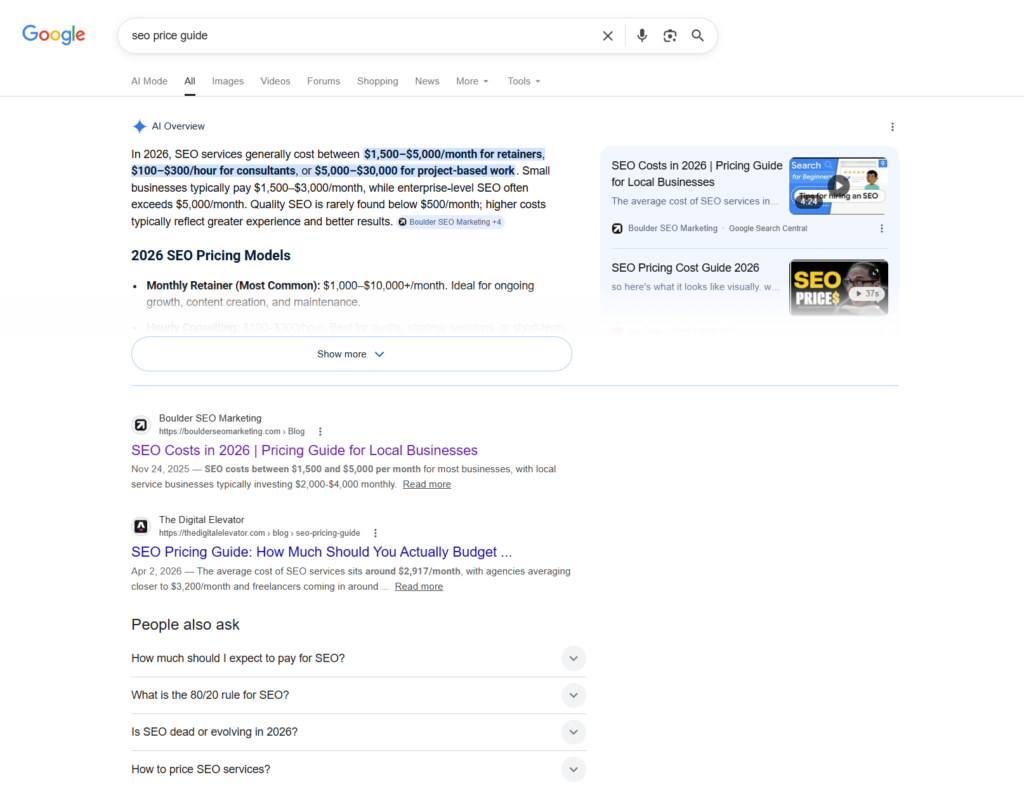
This is where the proof point matters. Late last year, we ran the exact same play on our SEO price guide page. We rebuilt it using the Universal Content Engine, grounded it in real pricing examples and specific figures from client engagements, and published the new version. That page now sits in the AI Overview for “SEO price guide,” ranks at the top of organic results, and consistently drives traffic, leads, and sales for our agency. It was a bit of work. It was absolutely time well spent.
What to Do Next
If you want more leads and sales from organic search, start here. Pull up Google Search Console, filter for pages with high impressions and low clicks in the last 28 days, and make a list of every URL that fits the pattern. Those are your sleeping giants. Read each page with fresh eyes and ask yourself if it genuinely delivers a “this is how I do it” experience, or if it is yet another surface-level how-to guide that could have been written about any business.
Once you have your list, prioritize by which page is closest to ranking for a keyword that actually drives your business. Not every sleeping giant is worth waking up. Some are ranking for queries that will never produce a real customer. Focus on the ones tied to how your ideal customers actually search.
If you want to see the exact methodology Chris is using to rebuild our own sleeping giant, he published a full walkthrough as an AI SEO Tip on his personal YouTube channel earlier this week that shows the process end-to-end, including the full prompting sequence. It is the clearest demo of the Universal Content Engine we have published to date.
If you want help running this on your own website, we are happy to walk through it with you. Our team at Boulder SEO Marketing does this for clients every single day, and we can show you exactly which pages on your site are sleeping giants and what the content fix looks like for your industry. Book a free strategy session and let’s take a look together.
Have an amazing Friday and a great weekend.
Stay safe and healthy,
Cheers,
The Boulder SEO Marketing Team